Implementation & Adjudication
This article examines the ongoing legal challenges to the constitutionality of Obamacare as posed by 21 state attorneys general. It explores how bureaucracies function within the U.S. political system, focusing on their role in implementing and enforcing laws. The piece highlights the characteristics of bureaucratic organizations, including their hierarchical structure, reliance on Standard Operating Procedures (SOPs), and merit-based recruitment. Additionally, it discusses the expansion of government bureaucracies throughout the 20th century and factors influencing the growth and reduction of these agencies.

Implementation & Adjudication
E N D
Presentation Transcript
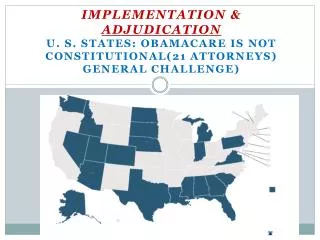
Implementation & Adjudication U. S. States: OBAMACARE IS NOT Constitutional(21 Attorneys) General Challenge)
Bureaucracies • Largest organizations in contemporary government • Encompass: members of the executive branch below the top executive
The Bureaucracy: Functions • Almost alone in implementing and enforcing laws and regulations • May articulate and aggregate interests • Adjudication • Involved in communication
Bureaucracy and Performance • Features of bureaucracies (Weber) • Decision making - based on fixed and official jurisdictions, rules and regulations; • Formal and specialized educational or training requirements for each position; • Hierarchical command structure: a firmly ordered system of super- and subordination, in which information flows upward and decisions downward; • Decisions - made on the basis of SOPs, which include extensive written records; and • Officials hold career positions, • appointed and promoted on the basis of merit • have protection against political interference (notably in the form of permanent job tenure).
Bureaucratic Expansion in Twentieth Century • Beyond watchman state model • Defense • Crime prevention • New areas of government involvement • Health • Productivity • Welfare
Other Factors in Bureaucratic Expansion • Inertia • Tendency of government to seek growth for its own sake • Reaction to above tendencies • Movement to reduce budgets • Movements to downsize bureaucracy
Recruitment into the Bureaucracy • Structure • Patronage • Dominant in 19th century • Remains common in third world • Civil service • Top political executives • Higher civil service (largely recruited from best universities) • Centrality of technical specialization