Download
1 / 7
80 likes | 205 Views
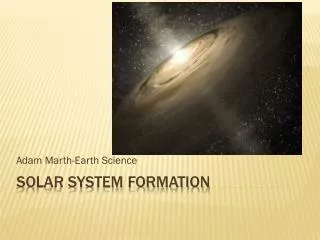
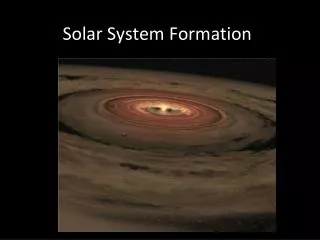
This article explores the intricacies of solar system formation, originating from a nebula, the cradle where new stars are born. It highlights the process of accretion, where dust grains combine due to electrostatic forces to form planetesimals. Through collisions, these bodies grow by melting their surfaces, acting like glue. The largest planetesimals attract more material via gravity, evolving into proto-planets. The dynamics of the nebula are driven by contraction due to gravity, heating at the center, and rotation that flattens the structure.

E N D
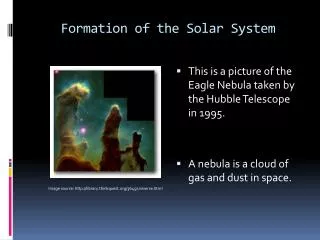
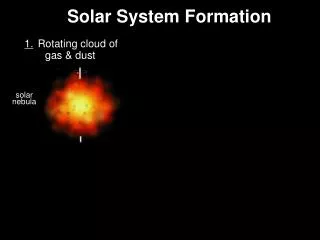
This is a nebula. This is where stars are forming.
Accretion • Dus grains stick together through electricity to form planetessimals. • Collisions between planetessimals melt the surface which acts as a “glue” causing them to grow larger. • Largest planetessimals pull in material through gravity and become proto-planets.
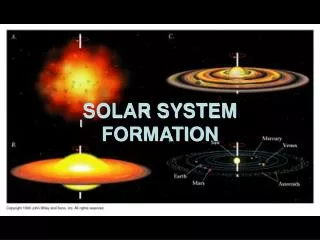
Gravity causes…. • The nebula to contract • The center heats up (from pressure) • Rotation causes… • The nebula to flatten out.