Understanding Pricing Strategies: Key Factors and Methods for Effective Price Planning
This comprehensive guide explores the importance of pricing in marketing, discussing how it reflects the value of goods and services for both buyers and sellers. It examines systematic price planning, factors influencing pricing decisions—including demand, costs, and competition—and various pricing strategies like cost-based, demand-based, and competition-based pricing. Additionally, the document addresses pricing adjustments, policy considerations, and the relationship between pricing and other marketing elements, providing insights for developing effective pricing objectives.

Understanding Pricing Strategies: Key Factors and Methods for Effective Price Planning
E N D
Presentation Transcript
Pricing The final element
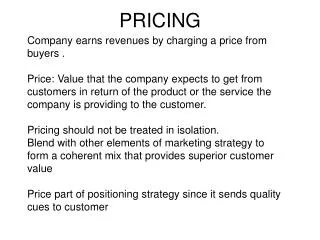
Price • Represents the value of a good or service for both the seller and the buyer • It describes all forms of purchase, both monetary and non-monetary
Price-planning • Systematic decision-making by an organization regarding all aspects of buying
Importance • Part of the exchange • Deregulation • Forms are more cost-conscious • Global economy= greater interest in currency valuations and exchange rates • In slow economies it is hard to raise prices
Relationship to other marketing elements • Prices vary over product life cycle • Affects customer service • Competitive with other firms, yet profitable • Sales force may need flexibility • As costs change, prices or other features may need to change
Approaches • Price-based • Non-price based
Factors affecting price • Demand • Costs • Government regulations (FTC) • Price fixing • Price discrimination • Unfair sales acts • Unit pricing • Price advertising • Channel members • Competition
Pricing objectives • Sales-based • Profit-based
Broad price policy • Sets the overall direction and tone for a firm’s pricing efforts and makes sure pricing decisions are coordinated with the firm’s choices as to a target market, an image, and other marketing mix factors
Methods of setting prices • Cost-based pricing • Demand based pricing • Competition based pricing
Cost-based pricing • Cost-plus pricing • Cost of the item + desired profit= price
Demand-based pricing • A firm sets prices after studying consumer desires and prices acceptable to the target market • Demand-minus pricing • Chain markup pricing • Price discrimination
Competition-based pricing • Using competitors’ pricing rather than demand or cost considerations as primary pricing guideposts • Price above • Price below • Meet competition • Price leadership
Considerations in implementing a price strategy • Customary vs. variable pricing • One price vs. flexible pricing • Odd pricing • Price-quality association • Leader pricing • Multiple unit pricing • Price lining • Price bundling • Geographic pricing • Purchase terms • Price adjustments
Customary vs. variable pricing • Customary pricing a firm sets prices and seeks to maintain them for an extended period of time • Variable pricing- lets a firm intentionally lower or raise prices in response to cost fluctuations or differences in consumer demand
One price policy vs. flexible pricing • One-price policy - lets a firm charge the same price to all customers seeking to purchase a good or service under similar conditions • Flexible pricing – a firm sets prices based on the consumer’s ability to negotiate or the buying power of a large customer
Odd pricing • Set prices below even dollar amounts
Price-quality association • Consumer may believe high prices represent high quality and low prices represent low quality • Prestige pricing
Leader pricing • Price select items low to attract customers
Multiple-unit pricing • A firm offers discount to customers to encourage them to buy in quantity, as to encourage overall sales volume
Price lining • Involves selling products within a range of prices, with each representing a distinct level of quality or features • Benefits • Constraints
Price bundling • Sell a basic product, options, and customer service for one total price
Geographic pricing • FOB mill or factory • FOB destination • Uniform delivered • Zone pricing • Base-point pricing
Purchase terms • Discounts • Payment timing
Price adjustments • List prices • Escalator clauses • Surcharges • Additional markups • Markdowns • Rebates