Discussion Session - Experiments
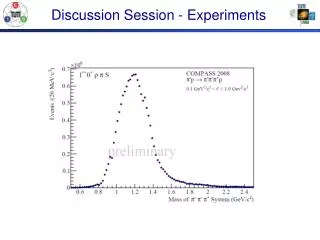
This discussion session focuses on recent results from experiments at BES III, COMPASS, and CLAS that delve into the study of exotic mesons and three-pion production. Presentations will include new findings on pi-pi amplitudes, isobar model analysis, and discussions on the complexities of analyzing multi-particle final states. Topics will cover systematic errors, diffraction patterns, and the importance of higher statistics in understanding production mechanisms. Experts from various institutions will share insights on enhancing analysis frameworks and data accessibility.

Discussion Session - Experiments
E N D
Presentation Transcript
Discussion Session - Experiments Conveners: C. Biniand B. Ketzer Recentresults on pi-piamplitudesat BES III (10’+5’) B. Liu (Institute of High EnergyPhysics) Searchforexotics in threepionproductionat COMPASS (10’+5’) S. Neubert (TU-Munchen) Searchforexotics in threepionproductionat CLAS (10’+5’) P. Eugenio (Florida State University) Discussion (45’)
Status of Analyses • Isobar model analysis • isobar parameterizations: r, (pp)S • rank of fit, full vs partial coherence • leakage, acceptance, resolution • t dependence • estimation of systematic error • Signals for exotic mesons • diffraction, pbarp: rp, hp, h’p, f1p, b1p • photoproduction: none • Scalar sector: • low-mass scalars • glueballvs ordinary qqbar
What is needed in the future? • Go beyond isobar model: • where does the model fail!? • include non-resonant production (dynamical effects, e.g. Deck) • understand a1! • multi-particle final states • coupled-channel analysis • final state interactions, unitarity • understand production mechanism: bins in t, s, polarization, probes • higher statistics, enlarge phase space • Tools, etc. • common PWA framework across different experiments • plugin for amplitudes • validation of software • computing: fitting procedures, GPUs, etc. • access to data