Analyzing 1-D Quantum States: From Bound to Unbound Continuum Dynamics
This article explores the transition from bound states in quantum mechanics to unbound states in a one-dimensional continuum. It discusses the implications of removing boundary conditions at infinity, leading to a continuum of allowed energy states. The normalization of wavefunctions in the context of free particles is examined, alongside the characteristics of wave packets. Key concepts include phase and group velocities, reflection and transmission coefficients in potential barriers, and the Ramsauer-Townsend effect. This text provides insights into the complexities of quantum behavior beyond confined systems.

Analyzing 1-D Quantum States: From Bound to Unbound Continuum Dynamics
E N D
Presentation Transcript
Mr. A. Square Unbound Continuum States in 1-D Quantum Mechanics
With Apologies to Shelley • In the previous section, we assumed • That a particle exists in a 1-d space • That it experiences a real potential, V(x) • That its wavefunction is a solution of the TISE or TDSE • That at infinity, its wavefunction is zero. • In this section, those are removed
The consequences • If the boundary condition at infinity is removed, • Then a quantum system is not limited to a discrete set of states but • A continuum of energies is allowed.
Normalizing Infinity • One problem if y(x)∞, how do you normalize it? • Well, Postulate 7 (wherein we discuss normalization) is based on the proviso that it mainly applies to bound states. • Mathematically, if we have to find a matrix element, we perform the following operation:
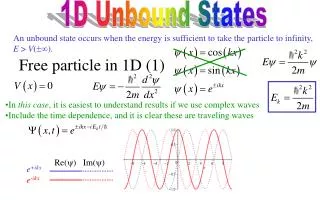
Assume k>0 & real, and B(k)=0, then Y describes a wave moving from –x to +x • Obviously, <p2>=2k2 • So • Dp=<p2>-<p>2 =0 • There is no variance in momentum, thus the free particle has mixed momentum • This is in agreement with Newton’s 1st Law
Assume k<0 & real, and A(k)=0, then Y describes a wave moving from +x to -x • Obviously, <p2>=2k2 • So • Dp=<p2>-<p>2 =0 • There is no variance in momentum, thus the free particle has mixed momentum • This is in agreement with Newton’s 1st Law
Obviously • eikx represents a particle moving from right to left • e-ikx represents a particle moving from left to right
The Wave Packet as a solution • Another solution to the TDSE is a “wave packet” • As an example, let B(k)=0 and the solution is in the form of the integral: • Note that this is the inverse Fourier transform • A complication arises in that w is not really independent of k
The Wave Packet cont’d • Typically, the form of A(k) is chosen to be a Gaussian • We also assume that w(k) can be expanded in a Taylor series about a specific value of k
The Wave Packet cont’d • The packet consists of “ripples” contained within an “envelope” • “the phase velocity” is the velocity of the ripples • “the group velocity” is the velocity of the envelope • In the earlier expansion, the group velocity is dw/dk
The phase velocity • So the ripple travels at ½ the speed of the particle • Also, note if <p2>=2k2 then I can find a “quantum velocity”= <p2> /m2 • 2k2/m2= E/2m=vq • So vq is the phase velocity or the quantum mechanical wave function travels at the phase speed
The Group Velocity • The group velocity (the velocity of the envelope) is velocity of the particle and is twice the ripple velocity. • BTW the formula for w in terms of k is called the dispersion relation
V(x)=V0 Region 2 Region 1 x=0 The Step Potential
Region 1 • “A” is the amplitude of the incident wave • “B” is the amplitude of the reflected wave
Region 2 • “C” is the amplitude of the transmitted wave
Matching Boundary Conditions • The problem is that we have 2 equations and 3 unknowns. • “A” is controlled by the experimenter so we will always solve ALL equations in terms of the amplitude of the incident wave
Applying some algebra • If E>V0 then E-V0>0 or “+” • Then k2 is real and y2 is an oscillator propagation • If E<V0 • Classically, the particle is repelled • In QM, k2 is imaginary and y2 describes an attenuating wave
V(x)=V0 V(x)=V0 Region 2 Region 2 Region 1 Region 1 x=0 x=0 Graphically • If E>V0 then E-V0>0 or “+” • Then k2 is real and y2 is an oscillator propagation • If E<V0 • Classically, the particle is repelled • In QM, k2 is imaginary and y2 describes an attenuating wave
Reflection and Transmission Coefficients • If k2 is imaginary, T=0 • If k2 is real, then
In terms of Energy, • If E<V0 then R=1 and T=0 • If E>V0 then
The Step Potential V(x)=V0 Region 2 Region 1 Region 3 x=0 x=a
Some Consequences • When ka=n*p, n=integer, implies T=1 and R=0 • This happens because there are 2 edges where reflection occur and these components can add destructively • Called “Ramsauer-Townsend” effect
For E<V0 • Classically, the particle must always be reflected • QM says that there is a nonvanishing T • In region 2, k is imaginary • Since cos(iz)=cosh(z) • sin(iz)=isinh(z) • Since cosh2z-sinh2z=1 • T cannot be unity so there is no Ramsauer-Townsend effect
What happens if the barrier height is high and the length is long? • Consequence: T is very small; barrier is nearly opaque. • What if V0<0? Then the problem reduces to the finite box • Poles (or infinities) in T correspond to discrete states
An Alternate Method We could have skipped over the Mr. A Square Bound and gone straight to Mr. A Square Unbound. We would identify poles in the scattering amplitude as bound states. This approach is difficult to carry out in practice
The Dirac Delta Potential • The delta barrier can either be treated as a bound state problem or considered as a scattering problem. • The potential is given by V(x)=-ad(x-x0) x=x0 Region 1 Region 2
From the previous lecture, the discontinuity at the singularity is given by:
Applying the boundary conditions • R cannot vanish or only vanishes if k is very large so there is always some reflection
Solving for k and E • This is in agreement with the result of the previous section. • If a is negative, then the spike is repulsive and there are no bound states
V(x) A Matrix Approach to Scattering Consider a general, localized scattering problem Region 1 Region 3 Region 2
Boundary Conditions • There are four boundary conditions in this problem and we can use them to solve for “B” and “F” in terms of “A” and “G”. • B=S11A+S12G F=S21A+S22G • Sij are the various coefficients which depend on k. They seem to form a 2 x 2 matrix • Called the scattering matrix (s-matrix for short)
Consequences • The case of scattering from the left, G=0 so RL=|S11|2 and TL=|S21|2 • The case of scattering from the right, F=0 so RR=|S22|2 and TR=|S12|2 • The S-matrix tells you everything that you need to know about scattering from a localized potential. • It also contains information about the bound states • If you have the S-matrix and you want to locate bound states, let kik and look for the energies where the S-matrix blows up.