Slide Note
0 likes | 11 Views
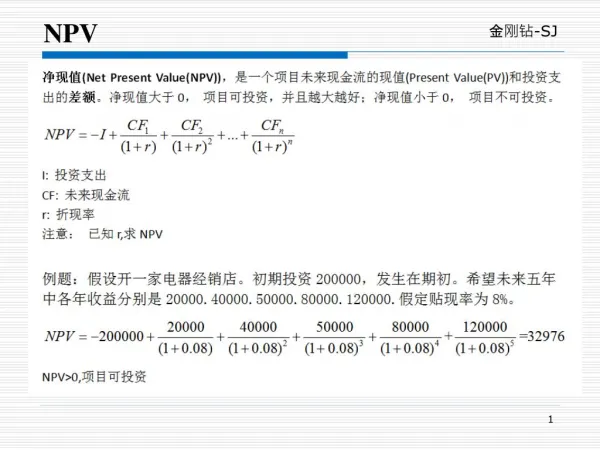
Net Present Value (NPV) and Internal Rate of Return (IRR) are essential tools in investment analysis and capital budgeting. NPV calculates the total value of future cash flows, while IRR determines the rate at which the project breaks even. They both consider the time value of money and aid in evaluating investment projects. Despite some similarities, NPV focuses on absolute value, whereas IRR represents the rate of return as a percentage. Understanding their differences and applications is crucial for making informed business decisions.

E N D
NET PRESENT VALUE VS. INTERNAL RATE OF RETURN
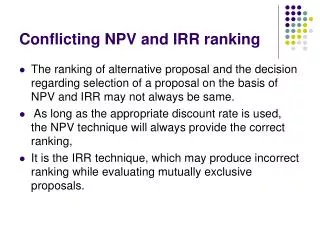
NET PRESENT VALUE VS. INTERNAL RATE OF RETURN Both the above are again widely used financial market tools that helps in investment analysis and capital budgeting. They measure the viability of investment and projects made by a business. However, let us find out their differences. The net present value is the final cash flow that a project will generate potentially, i.e., positive or negative returns. Whereas the internal rate of return is the discount rate at which the NPV becomes zero or reaches the break-even point. A point at investment equals total cash inflow. NPV values are required for calculating IRR. The former is the method used to calculate the rate of return in terms of percentage while the latter measures how much value the investment adds for the business. Compared to the former, the latter is considered a better and more reliable measure while comparing project that are mutually exclusive in nature.
NET PRESENT VALUE VS. INTERNAL RATE OF RETURN Unlike NPV, IRR can result in complex and multiple answers. Thus, both are equally valuable and useful metric for investment comparison and valuation. In reality, both are widely used in the financial markets to make informed business decisions.
SIMILARITIES BETWEEN NPV AND IRR Both methods are widely used in investment analysis and capital budgeting. They both consider the time value of money by discounting cash flows. They help assess the financial viability and profitability of an investment project. Both techniques consider future cash flows rather than historical financial data. NPV and IRR rely on the estimation of cash flows, making accurate projections critical for both methods. They provide insights into the potential return on investment. Both metrics are used to compare investment alternatives and aid in decision-making. They consider the initial investment or outflow of cash in their calculations. Both NPV and IRR require a predetermined discount rate. They are complementary metrics that, when used together, provide a more comprehensive evaluation of an investment opportunity.
WHAT ARE THE KEY DIFFERENCES BETWEEN NPV AND IRR? Category NPV IRR IRR represents the rate at which the total discounted cash inflows discounted cash representing the break-even for a project. IRR involves discount rate that makes the sum of equal to the sum of cash outflows, expressed percentage rate of return. IRR is the profitability of a project or the business in general and represented in the form of a percentage rate of return NPV represents the total value of future cash flows, whether positive or negative, brought back to the present time using a discount rate. equal outflows, the Definition finding the NPV involves using a discount rate to calculate the present value of cash flows and then subtracting investment to determine the net gain or represented in absolute terms cash inflows as a Calculation the initial loss. NPV is hence is
WHAT ARE THE KEY DIFFERENCES BETWEEN NPV AND IRR? Category NPV IRR The project is accepted if IRR is greater than the required return or cost of capital as the investment is then to be considered profitable. The project is accepted if NPV is positive (NPV > 0), as it indicates the investment is expected to generate more value than the initial cost. rate of Interpretation The computation of IRR is through a trial and error method which can be quite cumbersome and tedious compared to NPV. NPV understand calculate as compared to IRR is easier to and Ease of understanding as
WHAT ARE THE KEY DIFFERENCES BETWEEN NPV AND IRR? Category NPV IRR The net present value method appropriate for projects with longer durations. The return method is more suitable for with shorter durations. internal rate of is more Suitability projects NPV flexible IRR. It will provide a different result with the change discounting rate for the same projects. is relatively compared to IRR is not as flexible compared to the NPV Flexibility in the