
Structural Design Patterns
E N D
Presentation Transcript
Objectives • To introduce structural design patterns • Facade • Decorator • Composite • Adapter • Flyweight • Proxy
Facade Design Pattern • Design Purpose • Provide an interface to a package of classes. • Design Pattern Summary • Define a singleton which is the a means for obtaining functionality from the package.
Facade: Motivation • Clients communicate with the package (subsystem ) by sending requests to Facade, which forwards them to the appropriate package object(s).
Facade: Applicability • To provide simple interface to a complex package, which is useful for most clients. • To reduce the dependencies between the client and the package, or dependencies between various packages.
Facade: Consequences • It shields clients from package components, thereby reducing the number of objects that clients deal with and making the package easier to use. • It promotes weak coupling between the package and its clients and other packages, thereby promoting package independence and portability. • It doesn't prevent applications from using package classes if they need to.
Decorator Design Pattern • Design Purpose • Add responsibilities to an object at runtime. • Design Pattern Summary • Provide for a linked list of objects, each encapsulating responsibility.
Decorator: Class Model • Decorator creates an aggregated linked list of Decoration objects ending with the basic Substance object.
Decorator: Consequences • Why use Decorator when a simple vector of Component objects seems to suffice? • Instead of simple interface with a single Component object that Decorator provides, the client would have to know about the subclasses Substance and Decoration, thereby making the client code more specialized. • If other classes replaced Substance or Decoration, the client code would have to change. This is not the case when Decorator is used. • Therefore, Decorator would make the client’s interface more flexible.
Composite Design Pattern • Design Purpose • Represent a Tree of Objects. • Design Pattern Summary • Use a Recursive Form in which the tree class aggregates and inherits from the base class for the objects.
Composite: Consequences • Defines class hierarchies consisting of primitive objects and composite objects. • Makes the client simple. • Makes it easier to add new kinds of components.
Adapter Design Pattern • Design Purpose • Allow an application to use external functionality in a retargetable manner. • Design Pattern Summary • Write the application against an abstract version of the external class; introduce a subclass that aggregates the external class.
Adapter: Applicability • Use the Adapter pattern when • you want to use an existing class, and its interface does not match the one you need. • you want to create a reusable class that cooperates with unrelated or unforeseen classes, that is, classes that don't necessarily have compatible interfaces.
Adapter: Class Model • Adapter is based on the delegation form because an Adapter object delegates the command to the targeted command.
Adapter: Consequences • Adapter lets classes work together that couldn't otherwise because of incompatible interfaces.
Flyweight Design Pattern • Design Purpose • Manage a large number of objects without constructing them all. • Design Pattern Summary • Share representatives for the objects; use context to obtain the effect of multiple instances.
Flyweight: Consequences • Space savings increase as more flyweights are shared.
Proxy Design Pattern • Proxy • A class functioning as an interface to something else • Proxy Design Purpose • Avoid the unnecessary execution of expensive functionality like object creation or initialization in a manner transparent to clients. • Design Pattern Summary • Interpose a substitute class which accesses the expensive functionality only when required.
Proxy Usage Contexts • Virtual Proxy • Create an expensive object on demand (lazy construction) • Cache Proxy • Hold results temporarily • Remote Proxy • Use a local representative for a remote object (different address space) • Protection Proxy • Control access to shared object
Proxy: Consequences • Proxy promotes: • Efficiency: avoids time-consuming operations when necessary. • Correctness: separates design and code that are independent of retrieval/efficiency from parts concerned with this issue. • Reusability: design and code that are independent of retrieval efficiency are most likely to be reusable. • Flexibility: we can replace one module concerned with retrieval with another. • Robustness: isolates parts that check for the validity of retrieved data. • The penalties we pay can sometimes be too high: • If the proxy forces us to keep very large amount of data in the memory and its use is infrequent.
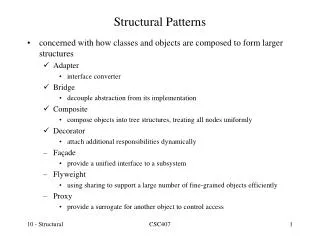
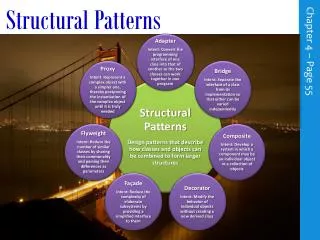
Summary of Structural Design Patterns • Structural Design Patterns relate objects (as trees, lists etc.) • Facade provides an interface to collections of objects • Decorator adds to objects at runtime • Composite represents trees of objects • Adapter simplifies the use of external functionality • Flyweight gains the advantages of using multiple instances while minimizing space penalties • Proxy avoids calling expensive operations unnecessarily