A Comprehensive Guide to Multiplying Polynomials and Using the FOIL Method
This guide provides detailed explanations and examples for multiplying polynomials, including the products of binomials. It covers the FOIL method with practical examples, ensuring a clear understanding of how to apply it to find polynomial products. The guide features various polynomial multiplication scenarios, combining like terms to simplify results. Each example is designed to engage learners, illustrating the step-by-step process to achieve accurate results in algebraic multiplication. Ideal for students seeking to enhance their math skills in polynomials.

A Comprehensive Guide to Multiplying Polynomials and Using the FOIL Method
E N D
Presentation Transcript
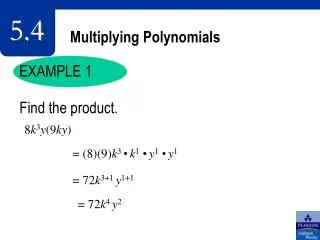
5.4 Multiplying Polynomials EXAMPLE 1 Find the product. 8k3y(9ky) = (8)(9)k3 •k1 •y1 •y1 = 72k3+1 y1+1 = 72k4 y2
EXAMPLE 2 • Find each product. a. –2r(9r – 5) = –2r(9r)– 2r(–5) = –18r2 + 10r
continued b. (2k – 5m)(3k + 2m) = (2k – 5m)(3k) + (2k – 5m)(2m) = 2k(3k) + (– 5m)(3k) + (2k)(2m) + (– 5m)(2m) = 6k2 –15km + 4km– 10m2 = 6k2 –11km – 10m2
EXAMPLE 3 • Find each product. a. (4x – 3y)(3x – y) 4x – 3y 3x – y Multiply –y(4x – 3y) –4xy + 3y2 12x2 – 9xy Multiply 3x(4x – 3y) 12x2 – 13xy + 3y2 Combine like terms.
continued • Find each product. b. (5a3 – 6a2 + 2a – 3)(2a – 5) 5a3 – 6a2 + 2a – 3 2a – 5 –25a3 +30a2– 10a + 15 10a4 – 12a3 + 4a2 – 6a Combine like terms. 10a4 – 37a3 + 34a2 – 16a + 15
When working with polynomials, the products of two binomials occurs repeatedly. There is a shortcut method for finding these products. • First Terms • Outer Terms • Inner Terms • Last terms CAUTION The FOIL method is an extension of the distributive property, and the acronym “FOIL” applies only to multiplying two binomials.
= 10r2 – 25r – 6r EXAMPLE 4 • Use the FOIL method to find each product. a. (5r – 3)(2r – 5) F O I L = (5r)(2r) + (5r)(–5) + (–3)(2r) + (–3)(–5) + 15 = 10r2 – 31r + 15 b. (4y – z)(2y + 3z) F O I L = (4y)(2y) + (4y)(3z) + (–z)(2y) + (–z)(3z) = 8y2 + 12yz – 2yz– 3z2 = 8y2 + 10yz – 3z2
EXAMPLE 5 • Find each product. a. (m + 5)(m – 5) = m2 –52 = m2 – 25 b. (x – 4y)(x + 4y) = x2 – (4y)2 = x2 – 42y2 = x2 – 16y2 c. 4y2(y + 7)(y – 7) = 4y2(y2 – 49) = 4y4 – 196y2
EXAMPLE 6 • Find each product. a. (t + 9)2 = t2 + 2• t • 9 + 92 = t2 + 18t + 81 b. (3k – 2n)2 = (3k)2 – 2(3k)(2n) + (2n)2 = 9k2 – 12kn + 4n2
EXAMPLE 7 • Find each product. a. [(x – y) + z][(x – y) – z] = (x – y)2–z2 = x2 – 2(x)(y) + y2–z2 = x2 – 2xy + y2–z2 b. (p + 2q)3 = (p + 2q)2(p + 2q) = (p2 + 4pq + 4q2)(p + 2q) = p3 + 4p2q + 4pq2 + 2p2q + 8pq2+8q3 = p3 + 6p2q + 12pq2 + 8q3
EXAMPLE 8 • For f(x) = 3x + 1 and g(x) = 2x – 5, find (fg)(x) and (fg)(2). (fg)(x) = f(x)• g(x). = (3x + 1)(2x– 5) = 6x2– 15x + 2x – 5 = 6x2– 13x – 5 Then (fg)(2) = 6(2)2 – 13(2) – 5 = 24 – 26 – 5 = –7.