
Exploring Switching Values in Prospect Theory: A Quantitative Analysis
This text outlines a methodology for determining switching values (y1, y2, y3, y4) in prospect theory. Participants evaluate their preferences between different monetary prospects, tinkering with €Y values, to identify thresholds at which their preferences switch. By substituting values from previous computations, individuals can analyze their decision-making processes under uncertainty. The study emphasizes the transition from preferring smaller or larger values based on the variances of the prospect in question, providing insights into behavioral economics.

Exploring Switching Values in Prospect Theory: A Quantitative Analysis
E N D
Presentation Transcript
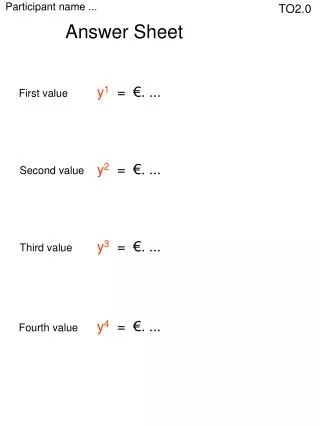
Participant name ... TO2.0 Answer Sheet y1 = €. ... First value y2 = €. ... Second value y3 = €. ... Third value y4 = €. ... Fourth value
TO2.1 Determining first number y1 Left prospect ½ ½ ½ ½ Right prospect €25 €Y €3 €16 • For small values of Y you prefer the right prospect. • For large values of Y you prefer the left prospect. • For some value of Y, which we call y1, your preference switches. • Fill this switching value in below, and then on page TO2.0. y1 = ...
TO2.2 Determining second number y2 First substitute your value y1 here. ... ½ ½ €3 €16 ½ ½ €Y • You have substituted your value y1. • Determine your switching value of Y again. • We call it y2 (obviously, y2 > y1). • Fill it in below and on page TO2.0. y2 = ...
TO2.3 Determining third number y3 First substitute your value y2 here. ... ½ ½ €3 €16 ½ ½ €Y • You have substituted your value y2. • Determine your switching value of Y again. • We call it y3 (obviously, y3 > y2). • Fill it in below and on page TO2.0. y3 = ...
TO2.4 Determining fourth number y4 First substitute your value y3 here. ... ½ ½ €3 €16 ½ ½ €Y • You have substituted your value y3. • Determine your switching value of Y again. • We call it y4 (obviously, y4 > y3). • Fill it in below and on page TO2.0. y4 = ...