Effective Public Relations: Key Principles for Successful Communication
Discover the essential basics of public relations in this informative presentation by Geoff Kirsch. Learn how to effectively engage with the public, build a positive reputation, and distribute vital information to consumers and the media. This session covers understanding your product and audience, crafting concise messaging, and utilizing various communication forms, including press releases and social media. Gain insights on developing relationships with journalists and ensuring your content is timely, accurate, and relevant to your audience.

Effective Public Relations: Key Principles for Successful Communication
E N D
Presentation Transcript
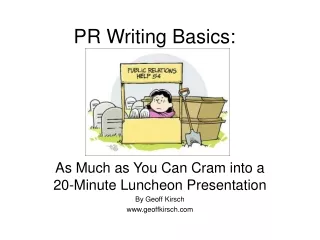
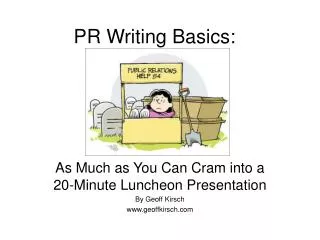
PR Writing Basics: As Much as You Can Cram into a 20-Minute Luncheon Presentation By Geoff Kirsch www.geoffkirsch.com
What is Public Relations? Public relations: It’s not just for crooks anymore. PR is how a company interacts with the public, maintains community ties and distributes important information to consumers, press and other interested parties. Not responding to scandal, but developing positive reputation.
Basic Principles of PR • Understand your product, customers, and industry • Understand your audience • Determine what forms of communication most effectively at reach that audience • Develop clear, concise messaging geared toward that audience • Provide interesting, accurate, valuable and timely information
Forms of Written PR • Press Release, Media Advisory, radio PSA • Newsletter • Website content • Opinion-Editorial or other “authored” piece • Social media: Facebook, LinkedIn, Google+, Twitter, Yelp!, Foursquare (April 16, National Foursquare Day)
Do the editors’ work for them. Supply: quotes, high-resolution photos with captions, well-written, well-edited, fact-checked and proofread press materials. Develop good relationships with journalists, editors. Timing: especially when trying to make editorial schedules for summer (get summer stuff out NOW) Ask: What’s the story? (Hints: Tie-in to holidays, tie-in to other items in the news cycle, “Alaska”, “you wouldn’t think it, but…”) Key facts first, inverted-pyramid Include contact information on everything: name, phone numbers, email (if electronic, links to your website) Effective PR Writing
Good PR Writing Takes • Patience • Practice • Perseverance • Planning • Possibly, another set of hands.