Comparative Analysis of Frog and Pig Anatomy for Evolutionary Insights
This lab analysis focuses on dissecting the anatomical differences and similarities between frogs and pigs, aiming to uncover evolutionary relationships and adaptations. Students will employ comparative methods such as T-charts or Venn diagrams to present their findings. Key analysis questions will guide the exploration of common ancestry indicators, unique adaptations for environmental survival, and predictive outcomes in the face of climate change. Additionally, students will identify homologies, reproductive advantages, and environmental pressures affecting each species' survival.

Comparative Analysis of Frog and Pig Anatomy for Evolutionary Insights
E N D
Presentation Transcript
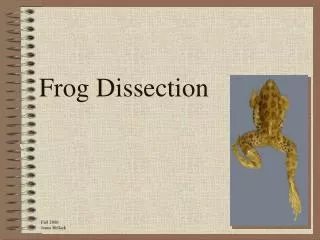
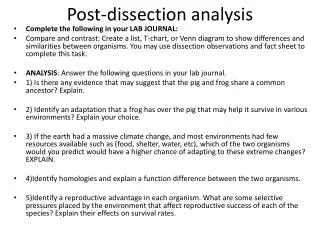
Post-dissection analysis • Complete the following in your LAB JOURNAL: • Compare and contrast: Create a list, T-chart, or Venn diagram to show differences and similarities between organisms. You may use dissection observations and fact sheet to complete this task. • ANALYSIS: Answer the following questions in your lab journal. • 1) Is there any evidence that may suggest that the pig and frog share a common ancestor? Explain. • 2) Identify an adaptation that a frog has over the pig that may help it survive in various environments? Explain your choice. • 3) If the earth had a massive climate change, and most environments had few resources available such as (food, shelter, water, etc), which of the two organisms would you predict would have a higher chance of adapting to these extreme changes? EXPLAIN. • 4)Identify homologies and explain a function difference between the two organisms. • 5)Identify a reproductive advantage in each organism. What are some selective pressures placed by the environment that affect reproductive success of each of the species? Explain their effects on survival rates.