Development of a Porous MgO Ceramic Water Filter Utilizing Nanocapillary Effect for Contaminant Removal
This study presents the fabrication of a novel water filter using porous MgO ceramics, aimed at effectively removing organic contaminants like benzene, xylene, and toluene. The filtering mechanism exploits the nanocapillary effect within the nanoporous structure, enhancing the catalytic activity of magnesium oxide and increasing the reactive surface area to treat contaminated water. This approach not only improves water purification efficiency but also offers reproducible production techniques for MgO ceramic filters, paving the way for advanced water treatment solutions.

Development of a Porous MgO Ceramic Water Filter Utilizing Nanocapillary Effect for Contaminant Removal
E N D
Presentation Transcript
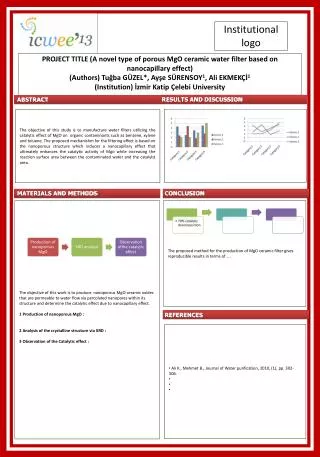
Institutional logo PROJECT TITLE (A noveltype of porousMgOceramicwaterfilterbased on nanocapillaryeffect) (Authors) Tuğba GÜZEL*, Ayşe SÜRENSOY1, Ali EKMEKÇİ1 (Institution) İzmir Katip Çelebi University RESULTS AND DISCUSSION ABSTRACT Theobjective of thisstudy is tomanufacturewaterfiltersutilizingthecatalyticeffect of MgO on organiccontaminantssuch as benzene, xyleneandtoluene. Theproposedmechanishmforthefilteringeffect is based on thenanoporousstructurewhichinduces a nanocapillaryeffectthatultimatelyenhancesthecatalyticactivity of Mgowhileincreasingthereactionsurfaceareabetweenthecontaminatedwaterandthecatalylstarea. PageMargin (Remove!) CONCLUSION MATERIALS AND METHODS Theobjective of thiswork is toproducenanoporousMgOceramicoxidesthatarepermeabletowaterflowviapercolatednanoporeswithinitsstructureanddeterminethecatalyticeffectduetonanocapillaryeffect. 1 Production of nanoporousMgO : 2 Analysis of thecrystallinestructurevia XRD : 3 Observation of theCatalyticeffect : Theproposedmethodfortheproduction of MgOceramicfiltergivesreproducibleresults in terms of …. REFERENCES • Ali K., Mehmet B., Journal of Waterpurification, 2010, (1), pp. 302-306.