Understanding Newton's Second Law of Motion and the Role of Friction
Newton's Second Law of Motion establishes a relationship between force, mass, and acceleration. It states that an object's acceleration increases with a larger applied force while also being influenced by its mass. This principle is crucial in understanding forces in motion, including friction, which opposes motion between surfaces. Various types of friction exist, such as static friction (motionless surfaces), sliding friction (sliding surfaces), and rolling friction (rolling objects). Additionally, air resistance impacts objects' speeds, contributing to terminal velocity when forces are balanced.

Understanding Newton's Second Law of Motion and the Role of Friction
E N D
Presentation Transcript
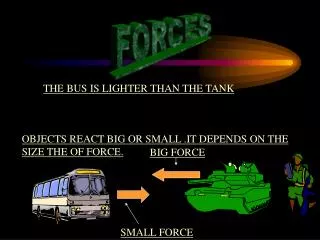
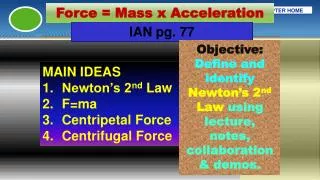
Newton’s Second Law • Forces and motion are connected. • An object will have greater acceleration if a greater force is applied to it. • The mass of an object and the force applied to it affect acceleration.
Newton’s second law of motion connects force, mass, and acceleration in the equation Acceleration equals net force divided by mass
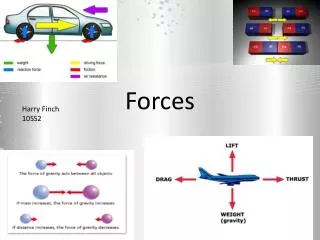
C. Friction - force that opposes motion between two surfaces that are touching each other. • Static Friction - Friction between two surfaces that are not moving past each other is called. • Sliding friction - force that opposes the motion of two surfaces sliding past eah other. • Rolling Friction - friction between a rolling object and the surface it rolls on.
Air resistance - opposes the motion of objects that move through the air. • The amount of air resistance depends on an object’s shape, size, and speed. • Terminal velocity - forces on a falling object are balanced and the object falls with constant speed.