Understanding Plate Tectonics and the History of Pangaea
This overview explores the theory of plate tectonics, beginning with Alfred Wegener’s concept of Pangaea, a supercontinent formed from all land masses. It discusses the initial skepticism of Wegener's theory and how further research led to its acceptance. The text explains different types of tectonic boundaries—convergent, divergent, and transform—and their geological impacts, such as the formation of mountains, volcanoes, and earthquakes. It also touches upon the real-world connections of these tectonic movements and their potential future consequences on the Earth's landscapes.

Understanding Plate Tectonics and the History of Pangaea
E N D
Presentation Transcript
Plate Tectonics By Amy Jo Jarboe
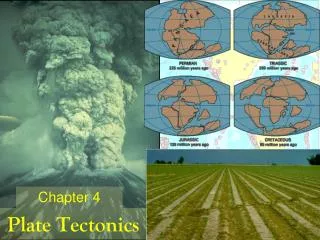
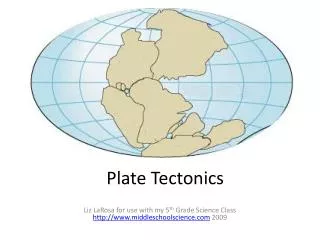
History of Pangaea • Alfred Wegener first thought of the theory of Pangaea. • He believed that all the continental land masses were in a gigantic supercontinent known as Pangaea. • He made a book called The Thermodynamics of the Atmosphere. • He also studied volcanoes, which really helped with his theory of pangaea • Arthur Holmes invented a theory around the same time. http://www.ucmp.berkeley.edu/geology/techist.html
History of Pangaea Cont. • The theory of a “super continent was not originally excepted by scientists, but as they researched more, they realized it was quite possible. • Pangaea lasted during the Permian and through the Jurassic period, when it started to break up. http://www.ucmp.berkeley.edu/geology/techist.html
History of Pangaea Cont. • Pangaea is Greek for “All Earth” • Eduard Suess helped recognize Wegener’s theory. He had discovered that there had once been a land bridge connecting all the continents except North America. • He found a fossilized plant, Glossopteris, found in many countries, which means that they were all connected at some point, proving Wegener’s theory. http://www.ucmp.berkeley.edu/geology/techist.html
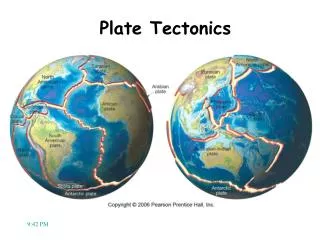
Convergent Boundaries • Convergent Boundaries are plates moving in opposite directions that meet. One is pulled underneath the other. • Another term for a boundary being pulled underneath another is subduction. http://www.ucmp.berkeley.edu/geology/techist.html http://scign.jpl.nasa.gov/learn/plate2.htm
Convergent Boundaries • You may find a Convergent boundary where there is a volcano, a mountain-looking thing that sends out lava and ash. Another sign may be Earthquakes, a bunch of vibrations in the Earth’s atmosphere. • A third sign is a land slides, when soil and other things fall down a hill, or avalanches. http://scign.jpl.nasa.gov/learn/plate2.htm
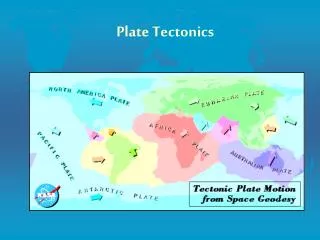
Convergent Boundaries • The Aleutian Trench is a good example of this. • This is where the Pacific Plate is getting pulled under the North American plate. • A Trench is a deep depression in the ocean that is narrow and very deep. http://scign.jpl.nasa.gov/learn/plate2.htm
Divergent Boundaries • Divergent Boundaries- Adjacent plates that are getting pulled apart. • They are also known as spreading plates. • The pulling apart causes sea floor spreading. http://scign.jpl.nasa.gov/learn/plate2.htm
Divergent Boundaries • You may find a divergent boundary where there is a mid ocean ridge. • . The divergent boundary is most likely underwater. http://scign.jpl.nasa.gov/learn/plate2.htm
Divergent Boundaries • The Mid Atlantic Ridge is a good example of this. • To the North, it divides the Eurasian plate and the North American plate. • To the South it separates the African plate from the South American plate. http://scign.jpl.nasa.gov/learn/plate2.htm
Transform Boundaries • Transform boundaries do have some problems though. • They cause mudslides, where mud and other debris goes down a hill. • All three types cause mountains. • A mountain is an elevation on the Earth’s crust. http://scign.jpl.nasa.gov/learn/plate2.htm
Transform Boundaries • Transform Boundaries are plates that slide past each other. • Boundaries are the limits something can move. • Plates are large areas in the lithosphere that react to tectonic movement. http://scign.jpl.nasa.gov/learn/plate2.htm
Real World Connections • We live on the North American Plate. • The only one the USA is a part of is the North American Plate. • The ones near it are Juan De Fuca, and the Pacific Plate. • We, personally are not in very much danger (from earthquakes, etc.) • There are areas that are, however. • Such as California, and Pennsylvania, for example. http://geology.com/plate-tectonics.shtml http://www.dnr.state.oh.us/geosurvey/html/geo_f03/tabid/8307/Default.aspx
Real World Connections • In the very distant future, I anticipate: • The U.S. will move. Not very fast, but it will move. • We will collide with another plate and cause anything from an earthquake, to a deep ocean trench • The continents will grow closer together, causing us to possibly go through another continental drift, but in reverse. http://www.dnr.state.oh.us/OhioGeologicalSurvey/GeologyTopics/GeologicHazards/tabid/7902/Default.aspx