Exploring Earth, Sun, and Moon Science
250 likes | 371 Views
Learn about the solar system, solar and lunar eclipses, rotation, revolution, moon phases, and famous astronomers in this comprehensive study of Earth, the Sun, and the Moon.


Exploring Earth, Sun, and Moon Science
E N D
Presentation Transcript
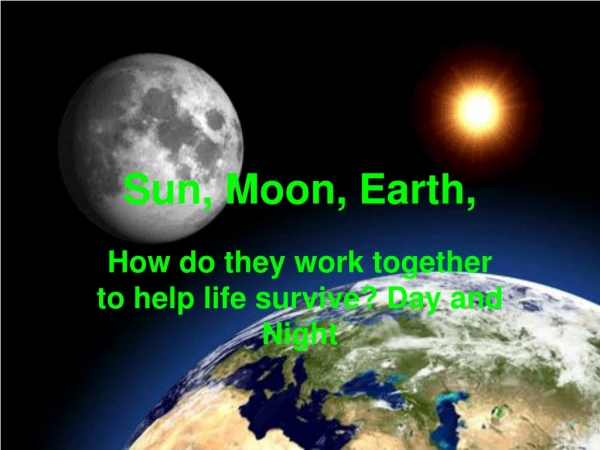
Earth, Sun, and Moon Science SOL 4.7
Solar System • The sun, the nine planets and their moons, and the other objects that orbit the sun.
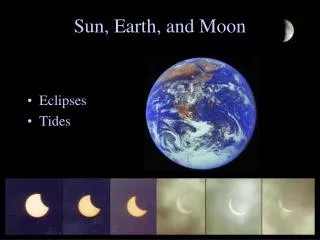
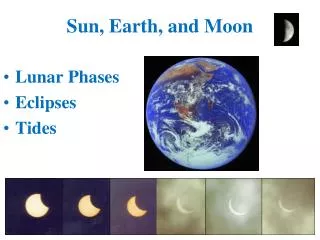
Solar Eclipse • The blocking of sunlight by the moon as the moon passes between the sun and the earth.
Rotation • One full spin of an object around an axis; the rotation of the Earth causes day and night.
Revolution • The movement of one object around an axis; the revolution of the Earth around the sun causes the seasons.
Lunar Eclipse • The darkening of the moon as it passes through the earth’s shadow.
New Moon • The moon is between the Earth and the sun; the sunlit side of the moon faces away.
First Quarter • One week after the new moon; half of the moon’s sunlit side of the moon faces away.
Full Moon • Two weeks after the new moon; the whole sunlit half of the moon faces the earth.
Last Quarter • Three weeks after the new moon; half of the sunlit side of the moon faces the Earth.
Moon Phases • The positions of the moon in its orbit around the Earth
Earth • The third planet from the sun; the planet where we live.
Axis • An imaginary line through a spinning object; the Earth rotates on its axis.
Season • One of the four periods of the year- spring, summer, fall, and winter.
Planet • A large body of matter revolving around the sun.
Ellipse • The shape of a circle that has been flattened a little.
Waxing • The moon phases leading up to a full moon.
Waning • The moon phases after the full moon.
NASA • National • Aeronautics and • Space • Administration
NOAA • National • Oceanic and • Atmospheric • Administration
Aristotle • The ancient philosopher who believed that the universe was a sphere with the Earth at its center.
Copernicus • Established the theory that the Earth revolved around the sun.
Ptolemy • Believed that the planets and the Sun orbited around the Earth.
Galileo • The first to use a telescope and discover evidence to support the theory of Copernicus.