Understanding Basic Electrical Concepts: Atoms, Circuits, and Static Electricity
This educational resource covers key concepts in electricity, including definitions of atoms, electrons, conductors, insulators, protons, and neutrons. It outlines the components of electrical circuits, identifies conductors and insulators, and explains the behavior of static and current electricity. Additionally, you'll find illustrations of atomic structure and circuit diagrams, along with explanations of concepts like the attraction of opposites, static electricity applications, and safety concerns at gas pumps. This comprehensive guide is designed for learners seeking to understand fundamental electrical principles.

Understanding Basic Electrical Concepts: Atoms, Circuits, and Static Electricity
E N D
Presentation Transcript
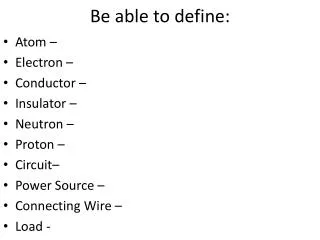
Be able to define: • Atom – • Electron – • Conductor – • Insulator – • Neutron – • Proton – • Circuit– • Power Source – • Connecting Wire – • Load -
Be able to identify: • The 3 parts of a circuit • 3 conductors • 3 insulators • 2 things you know about protons • 2 things you know about neutrons • 2 things you know about electrons • 2 ways we use static electricity • 2 ways that we use current electricity
Be able to illustrate • A diagram of atoms using the appropriate electron energy levels • A series circuit using a schematic diagram • A parallel circuit using a schematic diagram
Be able to explain • The difference between static and current electricity. • What does opposites attract mean? • How a balloon can stick to the wall with static electricity. • What does the stone amber have to do with static electricity? • Explain how lightening is an example of static electricityWhy is static electricity dangerous at the gas pump? • What is a Van de Graaff generator?