Understanding Factoring Quadratic Trinomials Using the FOIL Method
60 likes | 193 Views
This resource covers the essential process of factoring quadratic trinomials, emphasizing the FOIL method through practical examples. It shows how to multiply binomials such as (7x + 3)(2x + 4) step-by-step, demonstrating the combination of the first, outer, inner, and last terms to arrive at the expanded form. By converting a trinomial like x² + 3x + 2 back into its binomial factors, learners will grasp the relationship between standard form and its factors. This guide reinforces understanding of standard form as ax² + bx + c and the conditions for successful factoring.


Understanding Factoring Quadratic Trinomials Using the FOIL Method
E N D
Presentation Transcript
Factoring Quadratic Trinomialsa = 1 Chapter 10.5
RECALL: FOIL Example: Multiply using the FOIL method. (7x + 3)(2x + 4) O F (7x + 3)(2x + 4) I L F O I L = (7x)(2x) + (7x)(4) + (3)(2x) + (3)(4) = 14x2 + 28x+ 6x + 12 = 14x2 + 34x + 12
Factoring Quadratic Trinomials • Factoring is “undoing” FOIL. • Starting with an expression like • x2 + 3x + 2 • We’re going to rewrite this as the product of 2 binomials. X + 2 ( )( ) X + 1
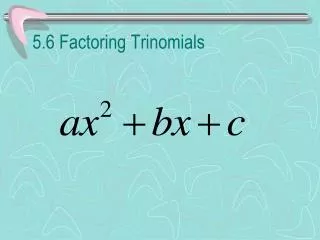
Standard Form: ax2 + bx + c • The Standard Form of any Quadratic Trinomials is ax2 + bx + c So for the example, 3x2 − 4x + 1 a = 3 b = −4 c = 1
Standard Form: ax2 + bx + c • EX. Find a, b and c • 4x2 + x − 2 • 2x2 − x + 5 • − x2 + 2x − 4 • x2 + 3x + 2
Factoring: ax2 + bx + c when a = 1 Find the two numbers whose product equals c AND whose sum equals b