Download
1 / 26
260 likes | 350 Views
Explore alternative EMS deployment strategies for the City of Milwaukee to improve revenue and service delivery, including dispatch fee charges and transport protocol adjustments. Analyze data sources and policy options to maximize fiscal impact while upholding service quality and public perception. Consider various revenue gains and cost reductions in the EMS system.

E N D
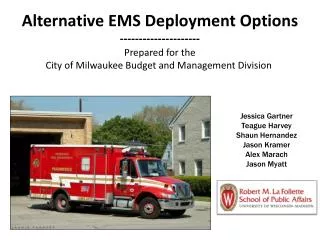
Alternative EMS Deployment Options --------------------- Prepared for theCity of Milwaukee Budget and Management Division Jessica Gartner Teague Harvey Shaun Hernandez Jason Kramer Alex Marach Jason Myatt
Introduction • Current Environment • State of Wisconsin’s 2011-13 biennial budget • 4.5 percent decrease in intergovernmental revenue for the City of Milwaukee • Property tax levy freeze on municipalities • Need for additional sources of revenue and enhanced efficacy of service delivery
Overview: EMS care in Milwaukee • Provided through a public-private partnership • Milwaukee Fire Department (MFD) responds to more serious emergency calls with its 12 med units • Four privately owned ambulance services respond to calls involving non-life threatening situations • Potential source of revenue gains and/or cost reductions
Policy objectives • Maximize net fiscal effect • Maintain quality of service • Ease of implementation • Public perception of EMS response • MFD and privates are at the same scene about 50,000 times per year (out of 93,383 calls)
Overview: EMS dispatch • Two levels of emergency medical services defined by Wisconsin Administrative Code • Basic Life Support (BLS) • Advanced Life Support (ALS) • MFD Dispatch divides EMS calls into three tiers • BLS-Private(lowest severity) • BLS-MFD (moderate severity) • ALS (highest severity)
BLS-Private NOTE: Private companies do not pay for dispatch services
Capacity for EMS care • EMS personnel work 24-hour shifts • Capacity: Amount of time EMS personnel can be in service. • Current in-service time is just over 4 hours per med unit per day • We analyze capacity of 6 and 8 hrs/day. • Based on: • Quality of care • Current run times and standards
Data sources • MFD Dispatch Data • All MFD unit dispatches from March 1, 2009, to February 14, 2011 • Includes information on unit status changes and responses (dispatched, en route, on scene, etc) • Accountability in Management (AIM) Report • Private provider dispatch data • Includes number of private calls for 2011
Policy Options for MFD • Charge dispatch fee • Transport all ALS-Downgrades • Transport all ALS-Downgrades + some BLS-MFD calls • Transport all BLS-MFD +ALS calls
Policy Option #1 • MFD charges a dispatch fee to private providers • MFD charges a $21 cost-recovery fee to the private providers for the dispatch services it currently provides • Fee based on (total dispatch costs) / (# of calls dispatched)
Analysis of Policy Option #1 • Net revenue increase of $1,706,000 • Based on (dispatch fee) x (calls dispatched to privates)
Transport status quo • MFD transports about 12,000 calls yearly • About 3,400 ALS-Downgrades transported by private ambulance companies • About 18,000 BLS-MFD-Private transports
Policy Option #2 • MFD transports all ALS-Downgrade calls • MFD begins transporting all of the calls it responds to as ALS calls reclassified on-scene as BLS calls • These calls currently turned over to private providers for transports.
Revenue generated per transport • $297.45 per transport on average • MFD bills more than is collected • Due to non-payment • Due to fixed reimbursement amounts
Analysis of Policy Option #2 • Net revenue increase of $1,024,000 • Based on (per transport revenue) x (added transports) Analysis of Policy Option #1 and #2 • Net revenue increase of $2,558,000 • Based on (Option #2 net revenue) + (revised Option #1 net revenue) • NOTE: Revenue from dispatch fee is decreased due to fewer calls being sent to private companies
Policy Option #3 • MFD transports ALS-Downgrades and some BLS-MFD calls, without adding personnel or equipment
Analysis of Policy Option #3 • Net revenue increase of $2,396,000 (6-hr. capacity) • Net revenue increase of $4,171,000 (8-hr. capacity) • Based on (per transport revenue) x (added transports) NOTE: Capacity assumption impacts estimate of the number of additional calls MFD can handle
Analysis of Policy Option #1 and #3 • Net revenue increase of $3,699,000 (6-hr. capacity) • Net revenue increase of $5,175,000 (8-hr. capacity) • Based on (Option #3 net revenue) + (revised Option #1 net revenue) • NOTE: Revenue from dispatch fee is decreased due to fewer calls being sent to private companies
Policy Option #4 • MFD transports all BLS-MFD and ALS calls • Would need to hire additional EMS personnel and purchase additional equipment (4 or 9 med units)
Analysis of Policy Option #4 • Net revenue increase of $1,625,000 (6-hr. capacity) • Requires 9 new med units and necessary personnel. • $524,000 annually per med unit. • Net revenue increase of $4,245,000 (8-hr. capacity) • Requires 4 new med units and necessary personnel. • Based on (per transport revenue) x (added transports)
Analysis of Policy Option #1 and #4 • Net revenue increase of $2,265,000 (6-hr. capacity) • Net revenue increase of $4,885,000 (8-hr. capacity) • Based on (Option #4 net revenue) + (revised Option #1 net revenue) • NOTE: Revenue from dispatch fee is decreased due to fewer calls being sent to private companies
Recommendations • Adopt Options #1 & #3 • MFD transports ALS downgrades and some BLS-MFD calls, without adding personnel or equipment • Implement a dispatch fee • Reexamine call to transport ratio and capacity efficiency issues • Net revenue increase of $3,699,000 (6-hr. capacity) • Net revenue increase of $5,175,000 (8-hr. capacity)
Implementation • Change dispatch methodology from closest first, to capacity sensitive dispatching • Slow, methodological scale-up of additional transports • Allows determination of actual MFD capacity • Manages risk of overloading med units and personnel • Determine best methods for maximizing capacity • Utilize feedback from personnel • Avoid personnel burnout • Monitor response times