Download
1 / 15
150 likes | 271 Views
This paper by Ling Zhao from the University of Alberta explores strategies in board games through the lens of combinatorial game theory. It evaluates the concept of direct threats within independent subgames, introducing methods like Thermograph analysis and various strategic approaches—such as the Sente and MaxMove strategies—aimed at optimizing gameplay. The findings of experimental results show that even simple strategies can be effective, with significant improvements noted from the HotStrat approach. This research presents new insights into computing optimal moves rapidly in complex game scenarios.

E N D
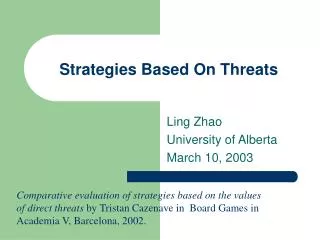
Strategies Based On Threats Ling Zhao University of Alberta March 10, 2003 Comparative evaluation of strategies based on the values of direct threats by Tristan Cazenave in Board Games in Academia V, Barcelona, 2002.
Outline • Motivations • Direct threats • Thermograph • Threat strategies • Experimental results
Motivations • Apply combinatorial game theory to Go - independent subgames - approach the best stategy
Direct threats • Each subgame has at most two moves
Root of the tree Black: 22 points White: 15 points Value: 7 points for black
Sequence after two black moves Black: 25 points White: 14 points Value: 11 points for black
Direct threat: 4 values A, B, C, D with A >= B >= C >= D Denoted as (A, B, C, D) After one black move => (A,B) After one white move => (C,D)
Problem model • Given a set of independent subgames with direct threats, how to compute good moves fast and accurately. (A1,B1,C1,D1) (A2,B2,C2,D2) . . . (An, Bn, Cn, Dn) Choose which subgame to play a move?
Thermograph • Temperature: 6.5 • Mean value: -4.5 Thermograph for direct threat (4,0,-6,-16)
Strategies • Optimal stategy: brute force (NP-hard?) • BMove: compare the best Left move (A,B,C,D) => value B (A,B) => value A • MaxMove: (A,B,C,D) => value B-C (A,B) => value A-B
Stategies • Sente Strategy A – B > MaxV => Sente C – D > MaxV => Reverse Sente Sente or Reverse Sente => MaxV *= 2 both => MaxV *= 4 • SenteQ Strategy Always choose sente or reverse sente moves first. Use MaxV to break ties.
Stategies • HotStrat: compare temperature • ThermoStrat: adding all the thermographs of all the subgame to choose the best subgame to play in.
Experimental results • Randomly choose 5 subgames (A>=B>=C>=D) • 8 Strategies playing against each other (56 games one round) • 100 rounds
Conclusions • Simple strategy is good enough! • Hotstrat strategy is easy to implement and can get 12% improvement. Problems (my thoughts) • Impact of imprecise evaluation? • How to generalize to more than 2 plies?