Download
1 / 24
240 likes | 367 Views
This guide introduces the Symbolic Model Verifier (SMV), an essential tool for verifying finite-state systems. It covers key concepts such as CTL formulas for specifications, OBDDs for internal representation, and the structure of SMV programs. The guide also details the characteristics of SMV language, modular descriptions, and the handling of nondeterminism. With practical examples and references to important resources, this introduction equips readers with the foundational knowledge needed to utilize SMV effectively in model checking applications.

E N D
Useful Links • CMU Model checking homepagehttp://www.cs.cmu.edu/~modelcheck/ • SMV windows versionhttp://www.cs.cmu.edu/~modelcheck/smv.html#nt • SMV man page (must read)http://www.cs.cmu.edu/~dongw/smv.txt • SMV manualhttp://www.cs.cmu.edu/~modelcheck/smv/smvmanual.ps
Symbolic Model Verifier • Ken McMillan, Symbolic Model Checking: An Approach to the State Explosion Problem, 1993. • Finite-state Systems described in a specialized language • Specifications given as CTL formulas + fairness, safety, liveness, deadlock • Internal representation using OBDDs • Automatically verifies specification or produces a counterexample
Language Characteristics • Allows description of synchronous and asynchronous systems • Modularized and hierarchical descriptions • Finite data types: Boolean and enumerated • Nondeterminism
Variable Assignments • Assignment to initial state: init(value) := 0; • Assignment to next state (transitionrelation)next(value) := value + carry_in mod 2; • Assignment to current state (invariant)carry_out := value & carry_in; • Use either init-next or invariant - never both • SMV is a parallel assignment language
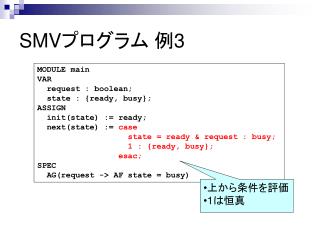
A Sample SMV Program MODULE main VAR request: boolean; state: {ready, busy}; ASSIGN init(state) := ready; next(state) := case state=ready & request: busy; 1: {ready, busy}; esac; SPEC AG(request -> AF (state = busy))
The Case Expression • case is an expression, not a statement • Guards are evaluated sequentially. • The first one that is true determines the resulting value • If none of the guards are true, an arbitrary valid value is returned • Always use an else guard!
Nondeterminism • Completely unassigned variable can model unconstrained input. • {val_1, …, val_n} is an expression taking on any of the given values nondeterministically. • Use union when you have expressions rather than values • Nondeterministic choice can be used to: • Model an implementation that has not been refined yet (e.g., abstract models of complex protocols) • Abstract behavior
Types • Boolean • 1 is true and 0 is false • Enumerated • VAR a : {red, blue, green}; b : {1, 2, 3}; c : {1, 5, 7};ASSIGN next(b) := case b<3 : b+1; 1 : 1; esac; • Numerical operations must be properly guarded • User can define its own data structures
ASSIGN and DEFINE • VARa: boolean;ASSIGNa := b | c; • declares a new state variable a • becomes part of invariant relation • DEFINEd:= b | c; • is effectively a macro definition, each occurrence of d is replaced by b | c • no extra BDD variable is generated for d • the BDD for b | c becomes part of each expression using d • not possible to provide non-determinism
Next • Expressions can refer to the value of a variable in the next state • Examples: • VAR a,b : boolean;ASSIGN next(b) := !b; a := next(b); • ASSIGN next(a) := !next(b)(a is the negation of b, except for the initial state) • Disclaimer: different SMV versions differ on this
Assignment Errors • Next/current value of a variable is assigned more than once (process) • Initial value of a variable is assigned more than once (program) • Initial/Current value of a variable are both assigned (program) • Current/Next value of a variable are both assigned (program) • Circular assignments
Circular definitions • … are not allowed! • This is illegal: • a := next(b);next(b) := c;c := a; • This is o.k. • init(a) := 0;next(a) := !b;init(b) := 1;next(b) := !a;init(c) := 0;next(c) := a & next(b);
Modules and Hierarchy • Modules can be instantiated many times, each instantiation creates a copy of the local variables • Each program has a module main • Scoping • Variables declared outside a module can be passed as parameters • Internal variables of a module can be used in enclosing modules (submodel.varname). • Parameters are passed by reference.
MODULE main VARbit0 : counter_cell(1); bit1 : counter_cell(bit0.carry_out); bit2 : counter_cell(bit1.carry_out); SPEC AG AF bit2.carry_out MODULE counter_cell(carry_in) VARvalue : boolean; ASSIGN init(value) := 0; next(value) := value + carry_in mod 2; DEFINEcarry_out := value & carry_in;
Module Composition • Synchronous composition • All assignments are executed in parallel and synchronously. • A single step of the resulting model corresponds to a step in each of the components. • Asynchronous composition • A step of the composition is a step by exactly one process. • Variables, not assigned in that process, are left unchanged.
Asynchronous Composition MODULE main VARgate1: process inverter(gate3.output); gate2: process inverter(gate1.output); gate3: process inverter(gate2.output); SPEC(AG AFgate1.output) SPEC (AG AF!gate1.output) MODULE inverter(input) VAR output: boolean; ASSIGN init(output) := 0; next(output) := !input;
Counterexamples -- specification AG AF (!gate1.output) is false -- as demonstrated by the following execution state 2.1: gate1.output = 0 gate2.output = 0 gate3.output = 0 state 2.2: [executing process gate1] -- loop starts here -- state 2.3: gate1.output = 1 [stuttering]
Asynchronous Composition (Revisited) MODULE main VARgate1: process inverter(gate3.output); gate2: process inverter(gate1.output); gate3: process inverter(gate2.output); SPEC(AG AFgate1.output) SPEC (AG AF!gate1.output) MODULE inverter(input) VAR output: boolean; ASSIGN init(output) := 0; next(output) := !input union output;
Example: Mutual Exclusion Module user VAR state : {idle, entering, critical, exiting}; ASSIGN init(state) := idle next(state) := case state = idle : {idle, entering}; state = entering & ! semaphore : critical; state = critical : {critical, exiting}; state = exiting : idle; 1 : state; esac; next(semaphore) := case state = entering : 1; state = exiting : 0; 1 : semaphore; esac; Module main VAR semaphore : boolean; proc1 : process user; proc2 : process user; ASSIGN init(semaphore) := 0; SPEC AG !(proc1.state = critical) SPEC AG !(proc2.state = critical) SPEC AG(proc1.state=entering -> AF proc1.state=critical)
Run SMV • smv [options] inputfile • -c cache-size • -k key-table-size • -m mini-cache-size • -v verbose • -r • prints out statistics about reachable state space • -checktrans • checks whether the transition relation is total
SMV Options • –f • computes set of reachable states first • Model checking algorithm traverses only the set of reachable states instead of complete state space. • useful if reachable state space is a small fraction of total state space
Variable Reordering • Variable reordering is crucial for small BDD sizes and speed. • Generally, variables which are related need to be close in the ordering. • –i filename –o filename • Input, output BDD variable ordering to given file. • -reorder • Invokes automatic variable reordering



![SMV [McMillan 93]](https://cdn1.slideserve.com/3422097/slide1-dt.jpg)