Strategies for Effective Product Development in Startups: Balancing Innovation and Risk
This guide explores essential strategies for effective product development in startups, emphasizing the importance of a structured approach. Key ideas include conceptual testing, engaging early customers, and obtaining valuable feedback. It highlights the significance of modular architecture, managing risks through small batch sizes, and the difference between sequential and concurrent processes. The guide also discusses maintaining flexibility while managing costs, ensuring a robust development framework that prioritizes learning from mistakes. Ultimately, it offers a blueprint for balancing speed with thoroughness in the startup environment.

Strategies for Effective Product Development in Startups: Balancing Innovation and Risk
E N D
Presentation Transcript
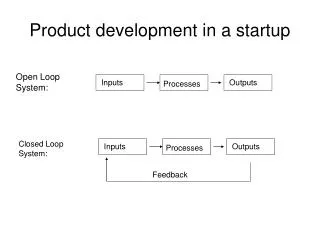
Inputs Outputs Processes Product development in a startup Open LoopSystem: Closed Loop System: Inputs Outputs Processes Feedback
Some general ideas on product development in a startup • Concept test • First customers – reference customers: • Choose wisely • Treat them well • Beta Test • Get feedback • Get agreement to talk to press, luminaries • Partnerships for offering, credibility
What else should we keep in mind?(from Smith and Reinertsen) • Don’t try to do everything all at once – break up the project if need be • Complexity adds interactions, which increase time and risk • Pick an appropriate pace – do you really need to be fast out of the gate? • Freeze the concept early • Have a plan • Make mistakes and learn from them
More Smith and Reinertsen • Architecture • How modularized? Consider function, cost performance • Interfaces: robust, stable • Concentrate risk in a few modules • Develop technology off the critical path • Overlapping Activities w/partial information • Avoid project overload
More S & R • Small batch size • Test early and often – do it, test it, fix it – usually; some projects have high test costs, though • Test higher risk elements early • Pull system integration earlier to manage technical risk • Customer input
Reinertsen -- Patterns • Sequential vs. concurrent process • Sequential is good for cost or risk minimization • Concurrent is good for cycle time, product cost, or product performance • Information profile • Early information is relatively costly, but reduces costly late changes
Patterns continued • Decentralized control vs. centralized control – becomes an issue when multiple development programs are underway • Location of large batch queues • Not a big issue until you have multiple programs • A few big “go / no go” points can efficiently manage risk in a startup • E.g. pre-first customer; pre-translation to market
Key Questions that Surface • How do you maintain flexibility with minimal $$?