Plate Tectonics
150 likes | 282 Views
The theory of plate tectonics reveals that Earth's lithosphere is divided into tectonic plates that drift slowly atop the asthenosphere. Initially, the Earth was a single supercontinent, Pangea, surrounded by one ocean. Over time, these plates moved apart, resulting in the formation of our current seven continents through processes like continental drift and sea-floor spreading. Different boundaries—divergent, convergent, and transform—describe how plates interact, leading to geological features like mountains and faults, exemplified by the San Andreas Fault and the Ring of Fire.


Plate Tectonics
E N D
Presentation Transcript
Plate Tectonics How the Earth moves
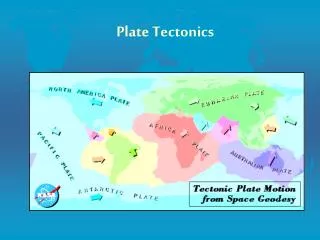
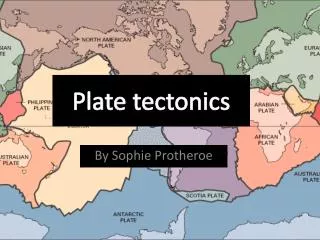
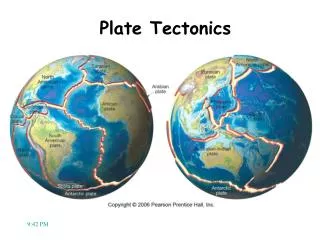
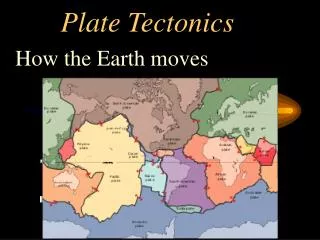
The Definition • The theory of plate tectonics states that the Earth’s lithosphere is divided into pieces called tectonic plates that move around on top of the asthensophere • Plates are either oceanic or continental
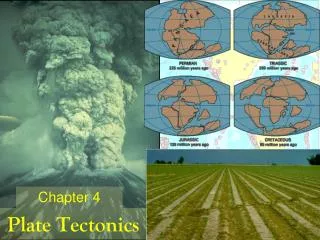
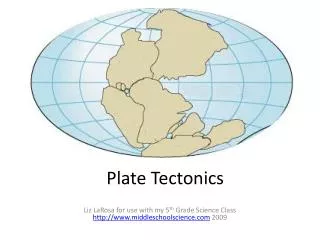
These plates drift very slowly—centimeters per year • Once, the world had one giant supercontinent, called Pangeaand one giant ocean. • Then, over time, the supercontinent spread out, forming the 7 continents we know today—this process is described as continental drift
Sea-floor Spreading • Magma rises from the mantle and solidifies—forming new oceanic lithosphere. • Once the magma has solidified into the rocky crust, it spreads out in either direction
Divergent Boundary • This is the boundary between two plates that are spreading away from one another • Like the ones found where sea-floor spreading occurs
Convergent Boundary • A convergent boundary is formed where two plates collide with each other • Three combinations exist: • Continental/continental • Continental/oceanic • Oceanic/oceanic
Transform Boundaries • A transform boundary can be found where two plates are sliding past each other horizontally • The most famous of which is the San Andreas Fault
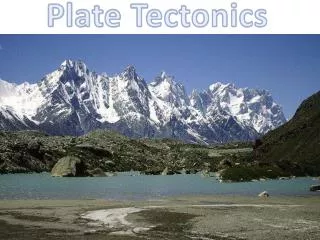
Types of Mountains—Folded • Folded mountains form at convergent boundaries where plates collide • Rock squeezes against rock, pushing it upward • These form the highest mountains in the world
Types of Mountains—Fault-Block • When the crust is tense, the rock can break along a series of faults, causing large rock blocks to drop down lower than other rocks
Types of Mountains—Volcanic • Volcanic mountains form when oceanic crust sinks into the asthenosphere by subduction • These rock melts, forming magma • This magma, under pressure, eventually rises and erupts through volcanic mountains