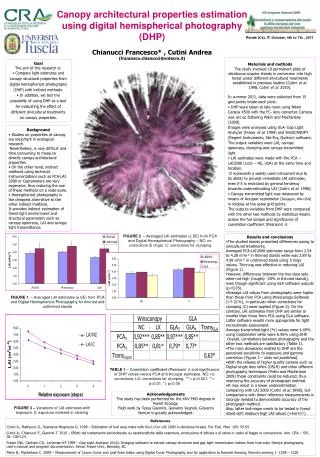
The CAN_EYE software for processing Digital Hemispherical Photos
110 likes | 252 Views
The CAN_EYE software provides a comprehensive tool for processing digital hemispherical photos, enabling users to derive essential metrics such as Leaf Area Index (LAI) and Fraction of Photosynthetically Active Radiation (fAPAR). With a suite of processing steps, it allows for image selection, preprocessing, classification, and robust reporting. Notably, CAN_EYE accounts for clumping effects in LAI estimation and offers traceability in processing. The software shows promising validation results and is available for free, aiming for future enhancements to improve accuracy and functionality in various conditions.


The CAN_EYE software for processing Digital Hemispherical Photos
E N D
Presentation Transcript
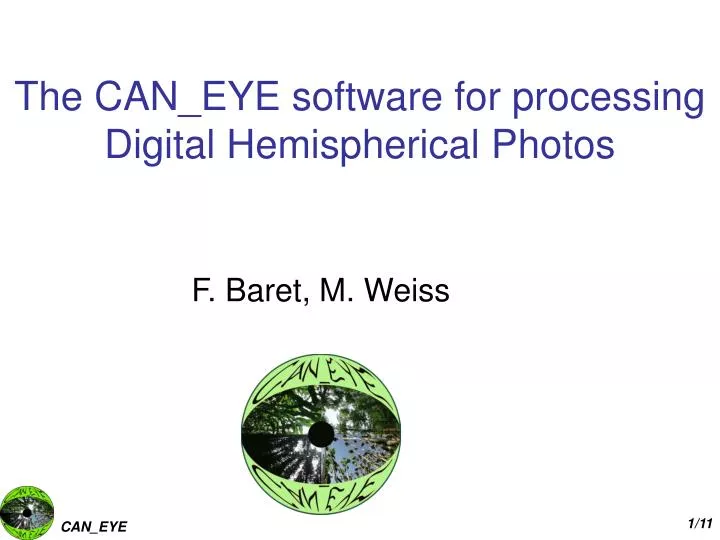
The CAN_EYE software for processing Digital Hemispherical Photos F. Baret, M. Weiss CAN_EYE
How to derive LAI from gap fraction • fCover= 1-Po(0) • fAPAR(qs)fIPAR(qs)=1-Po(qs) CAN_EYE
The LAI Po relationship CAN_EYE
Uncertainties in LAI estimates 0.08 0.04 0.02 0.01 -0.01 -0.02 -0.04 Error on Po -0.08 CAN_EYE
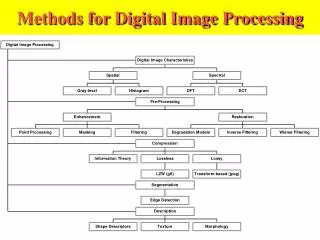
CAN_EYE: suite of steps Start Setup Image selection Preprocessing Classification Processing & reporting End CAN_EYE
Some results over Barrax Comparison of 2 independent processing CAN_EYE
Comparison with other methods Comparison with LAI2000 over Barrax By B. Martinez Comparison with destructive measurements by V. Desmarez (CESBIO) CAN_EYE
The P57 photos Using only the 57° direction allows to get better resolution But no more access to fAPAR (except at tetas=57°!) and fCover CAN_EYE
P57 photos Hemispherical photos Evidence of finer resolution CAN_EYE
Some results CAN_EYE
Conclusion • Software available (for free) (www.avignon.inra.fr/can_eye) • Advantages: • Quick and easy to use • Accounting for clumping in LAI • Provides estimates of fAPAR and fCover • Traceability of the processing • Some encouraging validation results • Potential problems: • Importance of illumination conditions: diffuse for looking down-ward • Potential problems when small gaps (resolution) • Not yet full documentation and references!! • Future enhancements • Inclusion of Chen’s/Leblanc/Fernandes clumping computation • Processing P57 photos • Slope correction • More validation • Development of autonomous light sensors (dynamics) CAN_EYE