Download
1 / 29
290 likes | 422 Views
This session provides a foundational understanding of epidemiology for those outside the field. It covers the essential roles of public health professionals, the interplay between human and technological tools in epidemiological practice, and the contributions of the Centers for Disease Control and Prevention (CDC). Participants will learn about key data sources, media collaboration, and various public health laboratories that support surveillance and outbreak investigation. Emphasizing teamwork, the session highlights the roles of various community partners in ensuring effective public health responses.

E N D
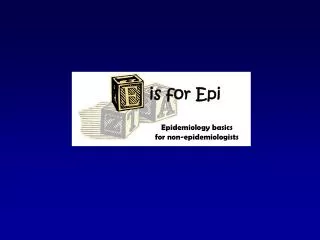
is for Epi Epidemiology basics for non-epidemiologists
Session IIPart I An Epidemiologist’s Toolkit
Overview • Public health, allied health, and community collaborators • Public health laboratories • Data, technology, and the media • Centers for Disease Control and Prevention • Universal epidemiological methods
Learning Objectives • Understand the significant roles of both the human and technological elements of epidemiological practice • Recognize the diverse professionals within and beyond public health that contribute to the success of epidemiological surveillance and investigations
Learning Objectives • Recognize key sources of epidemiological data • Recognize ways in which epidemiologists work with the media • Understand how the Centers for Disease Control and Prevention serves as a resource for training, technical support, and surveillance and reporting of epidemiological data
Colleagues & Collaborators • Public Health Regional Response Teams • First responders • Environmental health specialists • Public Health Laboratories • Disease investigation specialists
Traditional Fire Department Law Enforcement HazMat Emergency Medical Services Department of Transportation Environmental Protection Agency Non-traditional Hospitals Public Health Laboratories Public Works First Responders
Outbreak Investigation Triad Environmental Health Specialist Public Health Lab Epidemiologist
Outbreak Investigation Triad Roles of an epidemiologist • Determines existence of an outbreak • Determines a case definition, • e.g., “Onset of illness on or after February 1, 2005, with at least 2 of the following: diarrhea, fever, and vomiting” • Conducts interviews with cases, family members, contacts and controls • Generates a research hypothesis • Chooses an appropriate study design if an analytic study is conducted • Reviews, analyzes, and interprets interview, analytic study, and laboratory data
Outbreak Investigation Triad Roles of an environmental health specialist • Collects and tests food, water, or other environmental elements of interest • Inspects food service establishments for sanitation violations or deficiencies
Outbreak Investigation Triad Roles of a public health laboratorian • Cultures blood and / or stool samples • Identifies a pathogen and even the strain of pathogen via DNA fingerprinting (known as Pulse Field Gel Electrophoresis)
What Do Public Health Laboratories Do? • Confirm a situation that an epidemiologist is investigating • Everyday food borne illnesses • Bioterrorism biological threats • Serve as a liaison between the public and the public health system • Surveillance, monitoring, reporting • Essential to public health practice • Part of the public health infrastructure • Protect community health
Surveillance, Monitoring, Reporting • Surveillance • Vector borne diseases • Communicable diseases • Food borne and waterborne diseases • Monitoring • Newborn screening and genetics • Radiation monitoring and detection • Food safety or other environmental issues • Reporting • Two-way with state health departments
Association of Public Health Laboratories • National non-profit promoting policy and supporting practice at state and local levels • Has an Emergency Preparedness and Response initiative • Working relationship with CDC, EPA, FBI, Department of Homeland Security
CDC Division of Laboratory Systems Goal: “Assure availability of consistent laboratory capacity for public health across the nation.” • Demonstration Projects in four states (WA, NE, MN, MI) • Partnership • Assessment • Training • Standards
Epidemiology Tools Used at the Local Level • Common and uncommon tools used in investigations and response • How partnerships enhance outcomes • Within Public Health • Outside Public health
Investigation 1 Tuberculosis
TB Exposure Investigation Background • Hospital Nurse with active TB died • Several unknowns: • duration of infectiousness • number of patients exposed • number of hospital visitors exposed • identity of hospital visitors • No base-line data to compare screening findings
TB -Tools to Answer the Unknowns • Need strong relationships & diplomacy • Hospital staff (clinical & administration) • Neighboring health districts • State health department • Laboratory • Media • Community • Local health department staff
TB – Investigation & Response • Social & Professional Contacts • Coordinating three districts • Hospital employee and staff screening • Screening and testing patients and visitors • Approx. 900 patients & 1500 visitors • Outside help needed
TB: Evidence Based Decisions • Time to answer the unknowns • Period of infectiousness • Patient Reaction Rates over time of exposure • What patients were exposed? • Social & Professions infection rates • Do we expand time of exposure period?
TB - Outcomes • 2500 people screened • 2300 tuberculin skin tests • 2100 (92%) read • 128 positives • > 350 x-rays • 120+ hours of clinic time • New TB testing policy and employee illness monitoring at the hospital
Investigation 2 Foodborne Outbreak
Foodborne Outbreak (FBO) Background • 200 bed residential facility • Unknown cause of 30 GI illness complaints • Mentally handicapped population
FBO – Tools Required • Relationships • Facility staff • Laboratory • Media • Medical Examiner • Environmental Health program
FBO – Tools Required • Dedicated & knowledgeable Epidemiology Response Team • Interviewing skills • Outbreak investigation techniques • Analytic skills • Reliable references • Diplomacy & advocacy
Eat Chopped Pork BBQ Ill Not Ill Total Yes (exposed) 30 28 58 No (not exposed) 1 11 12 Total 31 39 70 FBO - Results • Cause of illness – Clostridium perfringens • 30 ill residents, 1 associated death • Improved food preparation and monitoring • Additional staff • Legislative measures for more funding AR = 51.7; RR = 6.2069; p = 0.000587
Common Toolbox Items • Control of Communicable Disease Manual • VDH Communicable Disease Manual • VDH Epidemiology web site www.vdh.state.va.us/epi/regs.asp www.vdh.state.va.us/epi/bulletin.asp • CDC web site www.cdc.gov • World Health Organization www.who.int/en/ • Pro-Med Mailwww.promedmail.org • And of course, paper & pen