Understanding Data Types and File Structures in Databases
This guide provides an overview of key database concepts, including data types, file structures, and the principles of data management. It addresses various file types such as sequential, serial, and index files, as well as direct access files. You'll learn about the importance of primary, secondary, and foreign keys, and how they relate to record maintenance, validation, and verification of data integrity. Practical examples are given, including how to search for information in a school database using various keys. Enhance your understanding of structured data storage and retrieval.


Understanding Data Types and File Structures in Databases
E N D
Presentation Transcript
FILE • TABLE • FIELD • ITEM • RECORD • KEY FIELD / PRIMARY KEY • SECONDARY KEY • FOREIGN KEY database
Sequential file – arranged according to the Primary Key • Serial file – no particular order • Difficult to find record • Index to locate randomly stored records • Direct access file Types of file
Updates / amendments of records • Addition of new records • Deletion of records FILE MAINTENANCE
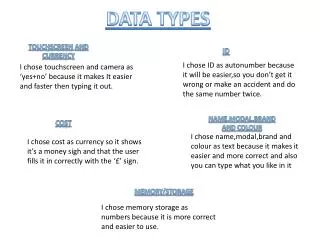
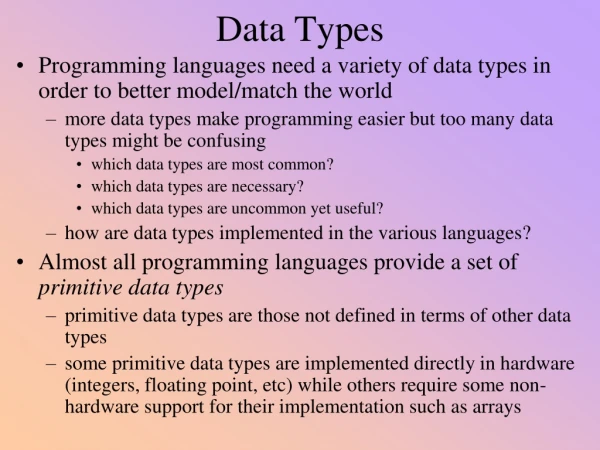
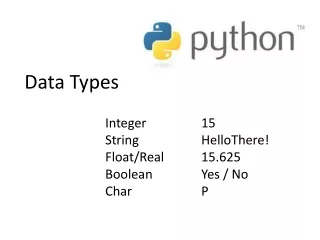
Numeric • Integers (counting) • Real numbers (measurement, etc) • Date • Alphanumeric • Logical / Boolean • Currency Data typeSTo constrain the data to a certain kind of information and range of values
Human error • False information • Information entered incorrectly • Validation check – set rules / format to the data type Checking Data ENtry
Length check • Character check • Format check • Is it possible for data to still be incorrect even though it has passed all validation check above? • Data verification – input data twice and compare VALIDATION CHECKe.g. date
All data stored in only one single file • requires a lot of memory • reduces speed of accessing the data FLAT FILES
Task: Find the Class Teacher’s Phone Number for Student X • Step 1: Search the Students File until it gets the correct Student • Step 2: Get the Class Teacher’s Name • Step 3: Search the Teachers File until it gets the correct Teacher • Step 4: Get the Teacher’s Phone Number Consider a school database that contains a STUDENTS FILE & TEACHERS FILE
Consider a school database that contains a STUDENTS FILE • Normally, Primary Key = Student ID • But students normally don’t remember their ID! • So Search by their Name - Secondary Key SECONDARY KEY
Data are stored in Tables • When data in different Tables are connected together,they form Relational Tables RELATIONSHIPS
Recall • Primary Key / Key Field • Secondary Key • Foreign key • A field in one file that is also a key field in another file FOREIGN KEY
Analogue • Can be any value within a defined range • E.g. • height of a person • Pressure • Light intensity • Digital • Discrete patterns of 0s and 1s • Only 2 states of single bit data • E.g. • On / Off • True / False • Yes / No ANALOGUE & DIGITAL DATA
Use A-D Converter • Burglar alarm / room thermostat take sample every second • Convert music to digital data 128 000 samples per second (kbps) • Use D-A Converter • Control lights during a concert complex switching, etc ANALOGUE & DIGITAL DATA CONVERSION