Download
1 / 17
170 likes | 297 Views
This document outlines a proposed mechanism for achieving fast BSS transition in mobile wireless networks. It addresses existing problems such as limited visibility of Access Points (APs) and the slow re-association process during mobility. Key phases include network initialization, information exchange to update associated Stations (STAs) and newly initialized APs, and the creation of an AP priority list for optimized roaming. Quick active scanning is introduced to minimize delay in the reassociation process, enhancing overall user experience in dynamic environments.

E N D
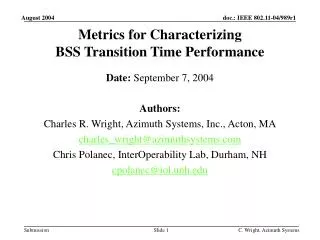
Quick Scan Mechanism for Fast BSS Transition Peyush Agarwal STMicroelectronics peyush.agarwal@st.com Peyush Agarwal, STMicroelectronics
Outline • Existing Problems for Fast BSS Transition • Achieving Fast BSS Transition • Network Initialization • Information Exchange: Updating STAs & Newly Initialized AP • AP_PRIORITY_LIST • Fast BSS Transition • The Concept • Quick Active Scanning • Tiny Probe Response • Limitation Peyush Agarwal, STMicroelectronics
Existing Problems Peyush Agarwal, STMicroelectronics
1. Limited Visibility of APs Mobile STA Not Visible to the mobile STA ESS Peyush Agarwal, STMicroelectronics
Limited Visibility → Scanning to be done when moving to other BSS → All the Re-association decisions has to be made on the run time. → Active data transfer suffers Peyush Agarwal, STMicroelectronics
Achieving Fast Transition Network Initialization PHASE 1 PHASE 2 PHASE 3 Fast BSS Transition Peyush Agarwal, STMicroelectronics
Network InitializationPHASE – 1 LEARNING For ‘Network Visibility’ Peyush Agarwal, STMicroelectronics
= Modified BEACON (ON ALL CHANNELS) N/w Table N/w Table N/w Table AP1 “INITIALIZATION” N/w Table Peyush Agarwal, STMicroelectronics
PHASE 2 :: Information Exchange“Updating STAs and newly Initialized AP” “Newly” Initialized AP N/w Table N/w Table Modified Beacon AP1 N/w Table Peyush Agarwal, STMicroelectronics
PHASE 2 • On receiving the ‘Modified Beacon’ frame from the “Newly initialized AP”, the receiving APs (that are already in the network): • Sends their Beacon information as a response (the newly initialized AP waits on each channel to receive the response). This updates the network information on all the APs • Sends the updated list (N/w table) TO the STAs associated with it • Note: On successful Association (initially), AP sends the STA’s ‘ContextX’, ‘SecurityX’, …, information to the associating STA with Fast BSS Transition support. • The STAs carry this information when moving from one BSS to the other and pass them to the new AP to be re-associated with. Peyush Agarwal, STMicroelectronics
Initializing AP invisible to other APs !! • Roaming STA provides Information • STA cross verifies the ‘N/w Table’ entries Peyush Agarwal, STMicroelectronics
Channel BSSID AP Infm #1 aaa *aaa_infm #2 bbb *bbb_infm *ccc_infm #7 ccc PHASE 3 :: “AP_PRIORITY_LIST” • STA sorts the “N/w Table”, based on the Beacon information received and prepares an “AP_PRIORITY_LIST” by putting the best matched AP on the top of the list, followed by the next match and so on. • Channels numbers also contribute to the AP_PRIORITY_LIST. On each channel, the ‘best’ AP is chosen. Furthermore, the best AP tops the list. • If the ‘N/w attributes’ are same on all APs, AP_PRIORITY_LIST would have the AP-on-the-same-channel first, followed by others. Sample AP_PRIORITY_LIST Peyush Agarwal, STMicroelectronics
Fast BSS Transition Peyush Agarwal, STMicroelectronics
The Concept • Once the mobile terminal starts moving to the other BSS, it: • Picks the first entry from the “AP_PRIORITY_LIST” (which would probably be the best AP). • Actively do QUICK SCANNING (described in the next slides) • If AP is found, it sends a ReassociationX frame to the new AP along with the context block and the security block embedded. • If no AP is found, it picks the next entry from the AP_PRIROTY_LIST and repeats the process. Peyush Agarwal, STMicroelectronics
Quick Active Scanning • Scans only on the selected channels (based on the AP_PRIORITY_LIST) • While scanning the mobile terminal it expects ‘Tiny’ probe response / beacons and not the ‘complete’ response frames. • Reduced waiting time to receive the probe response because of the “Tiny” probe response • Reduced ‘ProbeDelay’ Peyush Agarwal, STMicroelectronics
Probe Response BSSID Channel Number Tiny Probe Response (For Fast Scanning) • Beacon Interval • Capability Information • Supported rates • FH parameter set • DS parameter set • CF parameter set • IBSS parameter set • … Tiny Probe Response (7 bytes) * Can be extended based on the extensions supported Already Collected during AP Initialization Only ‘7’ bytes at the time of roaming Peyush Agarwal, STMicroelectronics
Limitation • SPEED at the cost of MEMORY. COMMENTS ? Peyush Agarwal, STMicroelectronics