Download

1 / 11
110 likes | 254 Views
This guide explains how to perform various operations on functions, including finding the sum, difference, product, quotient, and composition. To find the sum of two functions, add them and simplify by combining like terms in descending order. For the difference, subtract the second function from the first, ensuring correct distribution of negatives. The product requires using parentheses and multiplying each term from both functions. The quotient is straightforward; place the first function over the second. Lastly, learn how to compose functions by substituting one into another.

E N D
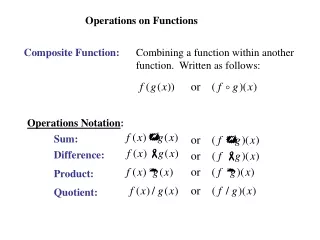
The sum f + g This just says that to find the sum of two functions, add them together. You should simplify by finding like terms. Combine like terms & put in descending order
The difference f - g To find the difference between two functions, subtract the first from the second. CAUTION: Make sure you distribute the – to each term of the second function. You should simplify by combining like terms. Distribute negative
The product f • g To find the product of two functions, put parenthesis around them and multiply each term from the first function to each term of the second function. FOIL Good idea to put in descending order but not required.
The quotient f /g To find the quotient of two functions, put the first one over the second. Nothing more you could do here. (If you can reduce these you should).
COMPOSITION OF FUNCTIONS “SUBSTITUTING ONE FUNCTION INTO ANOTHER”
The Composition Function This is read “f composition g” and means to copy the f function down but where ever you see an x, substitute in the g function. FOIL first and then distribute the 2
This is read “g composition f” and means to copy the g function down but where ever you see an x, substitute in the f function. You could multiply this out but since it’s to the 3rd power we won’t
This is read “f composition f” and means to copy the f function down but where ever you see an x, substitute in the f function. (So sub the function into itself).