Download
1 / 6
60 likes | 172 Views
This overview explains the fundamentals of electricity, focusing on electric current, voltage difference, and resistance. Electric current is the movement of electric charges in one direction, typically measured in amperes, where 1 ampere equates to 6.25 billion electrons flowing past a point each second. Voltage difference indicates how electric charge flows from higher to lower voltage and is measured in volts. Resistance, measured in ohms, refers to a material’s tendency to oppose the flow of electrons, converting electrical energy into thermal energy or light. Understanding these concepts is essential for studying electrical circuits.

E N D
Electric Current • The net movement of electric charges in a single direction • Electrons in a material (metal wire) are in constant motion in all directions = No Net Movement of electrons in one direction • In an electric current the electrons drift in the direction of the flow
Electric Current • Measured in Amperes • 1 Ampere = 6,250 million electrons flowing past a point every second
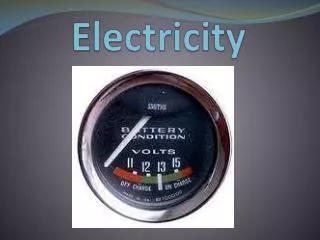
Voltage Difference • Electric Charge flows from higher voltage to lower voltage • Measured in Volts
Resistance • The tendency for a material to oppose the flow of electrons • Changes electrical energy into thermal energy or light • Measured in Ohms (Ω)
Ohm’s Law I Current (amperes) V Voltage Difference (volts) R Resistance (ohms) (89-90)