Understanding Strong and Weak Acids and Bases in Water
This article explores the behavior of strong and weak acids and bases in water. Strong acids, such as HCl, HI, and H2SO4, completely ionize in solution, producing a higher concentration of hydronium ions (H3O+) compared to weak acids like acetic acid (CH3COOH). Consequently, strong acids act as strong electrolytes and demonstrate lower pH values. Additionally, strong bases like NaOH and KOH dissociate completely in water, while other bases, such as NH3, exhibit weaker characteristics. Learn to distinguish between these substances based on ionization and reactivity.

Understanding Strong and Weak Acids and Bases in Water
E N D
Presentation Transcript
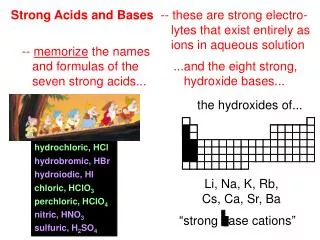
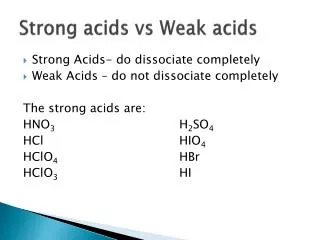
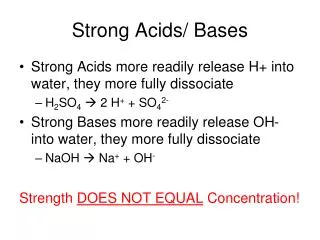
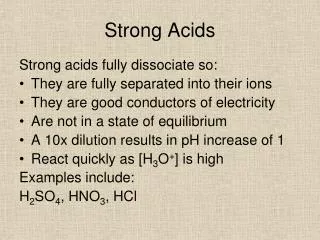
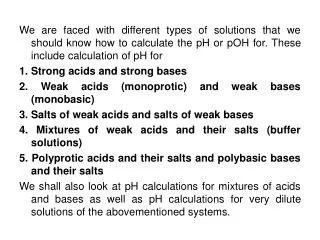
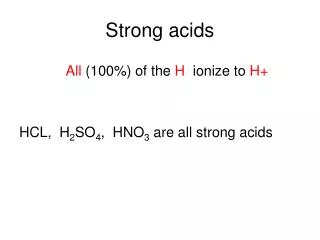
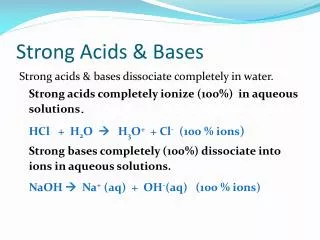
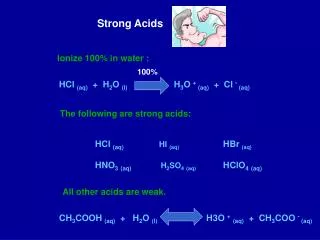
Strong Acids Ionize 100% in water : 100% HCl (aq) + H2O (l) H3O + (aq) + Cl - (aq) The following are strong acids: HCl (aq)HI (aq) HBr (aq) HNO3(aq) H2SO4(aq)HClO4(aq) All other acids are weak. CH3COOH (aq) + H2O (l) H3O +(aq) + CH3COO - (aq)
How Can we Distinguish a Strong Acid From a Weak Acid? Strong acids produce more hydronium ions when they ionize. Therefore: 1. Strong acids are strong electrolytes, weak acids are weak electrolytes. 2. Strong acids are more reactive than weak acids. 3. Strong acids have a lower pH than weak acids.
Strong Bases Dissociate completely when they dissolve in water: 100% NaOH (s) Na +(aq) + OH –(aq) Hydroxides of Group 1 & 2 metals are strong bases: LiOH NaOH KOH RbOH CsOH Mg(OH)2 Ca(OH)2 Ba(OH)2 Sr(OH)2 All other bases are weak. NH3(g) + H2O (l) NH4 +(aq) + OH -(aq)