Understanding Properties of Addition and Multiplication in Mathematics
540 likes | 657 Views
This lesson revisits key mathematical properties, focusing on both addition and multiplication. It covers the Commutative, Associative, and Identity Properties of Addition, emphasizing how numbers can be rearranged without affecting the outcome. The lesson then transitions to the properties of multiplication, introducing the Zero Property and the Distributive Property. Through clear examples, it illustrates how these properties apply in real-world scenarios, reinforcing the foundational understanding necessary for mastering multiplication.


Understanding Properties of Addition and Multiplication in Mathematics
E N D
Presentation Transcript
Multiplication Properties Lesson 2-1
Do you remember these Properties of Addition? • Commutative Property of Addition • The numbers move around • a + b = b + a • Associative Property of Addition • Grouping with parentheses • (a + b) + c = a + (b + c) • Identity Property of Addition • The identity of the problem does not change • a + 0 = a
In multiplication, you will see these same properties, plus 2 more…
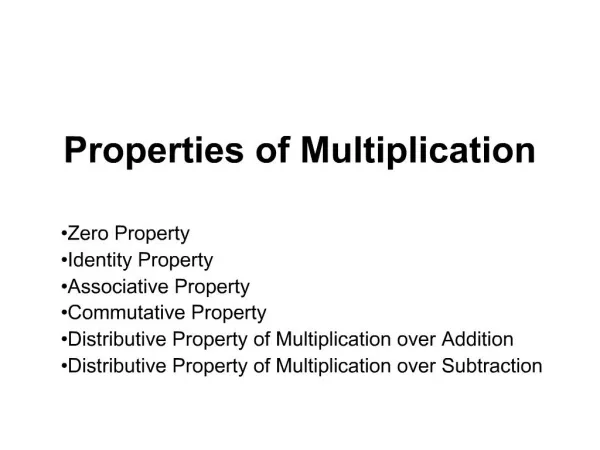
Five Properties of Multiplication • These are the basically the same as addition • Commutative • Associative • Identity • These belong to multiplication only • Zero • Distributive
Let’s review the addition properties— from the multiplicative perspective… Multiplicative (Do you see most of the word “multiply” in this word?
Property #1 The Commutative Property of Multiplication
The Commutative Property • Background • The word commutative comes from the verb “to commute.” • Definition on dictionary.com • Commuting means changing, replacing, exchanging, switching places, trading places • People who travel back and forth to work are called commuters.
Here are two families of commuters. Hi! Remember us? Commuter B Commuter A Commuter A & Commuter Bchangedlanes. Remember… commute means to switch places. Commuter A Commuter B
The Commutative Property A • B = B • A
3 groups of 5 = 5 groups of 3 3 x 5 = 5 x 3 = = 15 kids 15 kids
Remember… in Lesson 1-11 we saidthat the word “of” means multiply What commutative means to multiplication… 3 groups of 5 = 5 groups of 3 3 • 5 = 5 • 3 a • b = b • a
Property #2 The Associative Property of Multiplication
The Associative Property • Background • The word associative comes from the verb “to associate.” • Definition on dictionary.com • Associate means connected, joined, or related • People who work together are called associates. • They are joined together by business, and they have to talk to one another.
Let’s look at another hypothetical situation Three people work together. Associate B needs to call Associates A and C to share some news. Does it matter who he calls first?
A C B NO! Here are three associates. B calls A first He calls C last If he called C first, then called A, would it have made a difference?
(The Role of Parentheses) • In math, we use parentheses to show groups. • In the order of operations, the numbers and operations in parentheses are done first. (PEMDAS) So….
A C B A C B The Associative Property The parentheses identify which two associates talked first. (A B) C = A (B C) THEN THEN
Property #3 The Identity Property of Multiplication
The Identity Property I am me! You cannot change My identity!
One is the only number you can multiply something by and see no change.
Identity Property of Multiplication a x 1 = a x 1 =
Identity Property of Multiplication a x 1 = a x 1 = x 1 = x 1 =
These are 3 of the Properties of Multiplication • Commutative Property of Multiplication • The numbers move around • a •b = b • a • Associative Property of Multiplication • Grouping with parentheses • (a • b) • c = a • (b • c) • Identity Property of Multiplication • The identity of the problem does not change • a •1 = a
There are two more properties which are unique to multiplication • The Zero Property • The Distributive Property
Property #4 The Zero Property of Multiplication
The Zero Property of Multiplication • This looks like a mixture of the identity property of addition and the identity property of multiplication… • Be careful not to mix them up!
The Zero Property • Any time you multiply a number by zero, your answer is zero! If I have 2 pockets with NO money in them, then I have NO money! 2 • 0 = 0 The End
Property #5 The Distributive Property of Multiplication
The Distributive Property • Background • The word distributive comes from the verb “to distribute.” • Definition on dictionary.com • Distributing refers to passing things out or delivering things to people
The Distributive Property a(b + c) = (a • b) + (a • c) A times the sum of b and c = a times b plus a times c Let’s plug in some numbers first. Remember that to distribute means delivering items, or handing them out. Here is how this property works: 5(2 + 3) = (5 • 2) + (5 • 3)
You have sold many items for the RCMS fundraiser! You went to two houses on one street and three houses on a different street. Every family bought 5 items! 5(2 + 3) = (5 • 2) + (5 • 3) You went to two houses on one street and three houses on a different street. Every family bought 5 items!
5(2 + 3) = (5 • 2) + (5 • 3) You distributed (delivered) these all in one trip. There are (2+3) five houses all together. You need to deliver 5 gifts to each house. You need to put 25 items on your wagon at one time. 5 items x 5 houses = 25 items all together
5(2 + 3) = (5 • 2) + (5 • 3) and 10 You distributed your items in two trips (+). On the first trip you distributed 5 items to each of 2 houses (5 x 2 = 10). On the second trip you distributed 5 items to each of 3 houses (5 x 3 = 15). That means you distributed (delivered) 10 items plus 15 items. That makes 25 items altogether. + 15 25
The Distributive Property Make 1 trip. You have 5 houses. You need to bring 5 items to each house. You need 25 items on your wagon. DISTRIBUTION CENTER 5(2 + 3)
The Distributive Property Make 2 trips. You have 2 houses for your first trip and you need to bring 5 items to each house. You have 3 houses on your second trip and need to bring 5 items to each house. When your second trip is over, you will have distributed 25 items. DISTRIBUTION CENTER (5 • 2) + (5 •3)
How do I tell the properties apart? • Commutative • Numbers switch places • Associative • Parentheses on both sides • Only multiplication on each side • Identity • Multiply by 1 • Zero Property • Multiply by zero • Distributive • Parentheses on each side • One side has a multiplication sign AND a plus sign
Let’s practice ! Look at the problem. Identify which property it represents.
4(5 + 6) = (4 • 5) + (4 • 6) The Distributive Property of Multiplication • 3 numbers on one side—4 on the other • Multiplication AND addition • 3 sets of parentheses
987 • 1 = 987 The Identity Property of Multiplication • Times 1
3 • 0 = 0 Zero Property of Multiplication • Times zero
(1 • 2) •3 = 1 • (2 • 3) The Associative Property of Multiplication • Same 3 numbers • Multiplication only • 2 sets of parentheses
6 • 11 = 11 • 6 The Commutative Property of Multiplication • Same 2 numbers • Numbers switched places
9 • 7 = 7 • 9 The Commutative Property of Multiplication • Same 2 numbers • Numbers switched places
12 • 0 = 0 Zero Property of Multiplication • Times zero
(9 • 8) •7 = 9 • (8 • 7) The Associative Property of Multiplication • Same 3 numbers • Multiplication only • 2 sets of parentheses
9(8 + 7) = (9 • 8) + (9 • 7) The Distributive Property of Multiplication • 3 numbers on one side—4 on the other • Multiplication AND addition • 3 sets of parentheses
9 • 1 = 9 The Identity Property of Multiplication • Times 1
a • 1 = a The Identity Property of Multiplication