Understanding Lewis Structures, Resonance, and Stoichiometry of Common Molecules
This guide explores the Lewis structures of various common molecules including H2, CO, N2, and more. It details the concepts of formal charge and oxidation numbers, highlighting examples like the azide ion and permanganate ion. Additionally, the significance of resonance in stabilizing molecular structures is discussed, using BF3 and NO2F as case studies. The stoichiometry of covalent molecules is also covered, explaining how valence electrons contribute to bonding interactions, including dative covalent bonds.

Understanding Lewis Structures, Resonance, and Stoichiometry of Common Molecules
E N D
Presentation Transcript
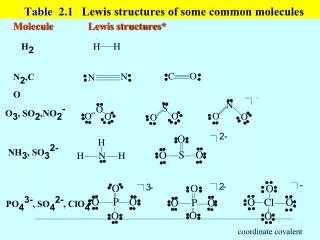
Table 2.1 Lewis structures of some common molecules H H N H N N S O O O O O O H N H P O O O 3 - O Cl O O O P O - O 2- O O O O O S O O coordinate covalent 2 - Molecule Lewis structures* H2 C O N2,CO O3, SO2,NO2- NH3, SO32- PO43-, SO42-, ClO4-
What is the oxidation number of (a) nitrogen in the azide ion, and (b) manganese in the permanganate ion, (a) 3 x O.N(N) = -1. O.N.(N) = Oxidation number of an element (b) O.N.(Mn) + 4 x O.N.(O) = -1 O.N.(Mn) = -1-4x(-2) = +7.
In fact these are called the the resonance structures of the carbonate oxyanion. Resonance
Resonance has two man effects: The BF3 molecule, for instance, is a resonance structures 1. Resonance averages the bond characteristics over 2. Resonance reduces the energy of the molecule any single contributing structure.
Write resonance structures for the NO2F molecule and identify the dominant structures.
Stoichiometry of covalent molecules In this way the stoichiometry of covalent molecules is determined by the number of valence electrons available for sharing and forming two electron pairs. Dative covalent bond.