
Analyzing Movement Components in Rehabilitation Tasks for Arm Paralysis
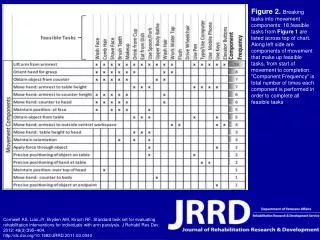
This chart analyzes 18 feasible tasks identified in Figure 1, breaking them down into their respective movement components. It lists the components of movement from initiation to completion along the left axis, while the top row showcases the corresponding tasks. The "Component Frequency" indicates how many times each movement component is performed to complete all feasible tasks, providing insights into task analysis and rehabilitation effectiveness. This framework aids in evaluating rehabilitation interventions for individuals with arm paralysis, enhancing therapeutic strategies.

Analyzing Movement Components in Rehabilitation Tasks for Arm Paralysis
E N D
Presentation Transcript
Figure 2. Breaking tasks into movement components: 18 feasible tasks from Figure 1 are listed across top of chart. Along left side are components of movement that make up feasible tasks, from start of movement to completion. "Component Frequency" is total number of times each component is performed in order to complete all feasible tasks Cornwell AS, Liao JY, Bryden AM, Kirsch RF. Standard task set for evaluating rehabilitation interventions for individuals with arm paralysis. J Rehabil Res Dev. 2012; 49(3):395–404.http://dx.doi.org/10.1682/JRRD.2011.03.0040