Download
1 / 22
220 likes | 330 Views
This guide covers essential methods for identifying and understanding minerals based on insights from Chapter 4 of the Earth Science book. Key concepts include recognition by color, luster, crystal system, and hardness, along with practical tests like streak, cleavage, and acid reactions. The importance of mineralogy and classification of minerals like silicates, carbonates, and oxides is discussed. It also emphasizes the significance of visual and physical properties in accurate identification, providing a valuable resource for students and enthusiasts of earth sciences.

E N D
How to Know Minerals read pages 46-57 Chapter 4 Earth Science Book restate & answer Topic Questions 1-9 practice the 30 lab mineral samples
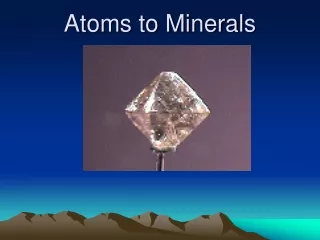
Topic 1: Page 47 Earth Textbook Rock-Forming Minerals * over 2000 minerals known * most are silicates (Si + O + metals) common minerals that make up the Earth’s crust * not always large crystals *mineralogy is the study of minerals and their properties
Topic 2: Page 47-48 Earth Textbook Identification by Inspection *Color simple observations made by looking *Luster *Crystal System (shape)
Topic 2: Page 47 Earth Textbook Color * first, most easily observed * least useful when identifying minerals 1. impurities change mineral’s colors 2. mineral’s colors are similar 3. colors change/react in air
Topic 2: Page 47 Earth Textbook Luster * Metallic Luster * Nonmetallic Luster the way a mineral shines
Topic 2: Page 47 Earth Textbook Metallic Luster *shines like polished metal *(galena, pyrite, chalcopyrite)
Topic 2: Page 47-48 Earth Textbook Nonmetallic Luster *vitreous – shining glass (quartz) *pearly – like a pearl (mica) *resinous – like wax (sphalerite) *greasy, oily – (talc & graphite) *dull, earthy – (kaolinite, limonite) *brilliant, adamentine – (diamond)
Topic 2: Page 47-48 Earth Textbook Crystal System (shape) *cubic – all 90º, all lengths equal *orthorhombic – all 90º, no lengths equal *tetragonal – all 90º, some lengths equal *triclinic – none @ 90º *monoclinic – some @ 90º *hexagonal – 3 axes @ 60º
Topic 3: Page 48-50 Earth Textbook Identification by Simple Tests *Streak *Fracture or Cleavage *Hardness
Topic 3: Page 48 Earth Textbook Streak * rub mineral on unglazed white tile metallic - streak dark as mineral the color of a mineral’s powder nonmetallic - streak colorless to light
Topic 3: Page 49 Earth Textbook Cleavage 1 direction – micas, gypsum, talc 2 directions – feldspars, hornblende minerals split along flat surfaces 3 directions – galena, halite, calcite
Topic 3: Page 49 Earth Textbook Fracture • concoidal fractures – shell-like fracture • fiberous or splintery – jagged and sharp minerals break along non-cleavage surfaces • uneven or irregular – rough surface
Topic 3: Page 49-50 Earth Textbook Hardness *Mohs’ Hardness Scale – page 50 in text • minerals ranked on a scale of 1 to 10 minerals resistance to being scratched • need fingernail, copper, steel, glass, topaz • 1 softest (talc), 7 hardest common (quartz) and 10 is the hardest of all (diamond)
Topic 4: Page 50 Earth Textbook Specific Gravity • specific gravity = mass of sample in air mass lost in water the ratio of the mass of a mineral to the mass of an equal volume of water • nonmetals - less than 4 • metals - above 5
Topic 5: Page 51 Earth Textbook Acid Test *calcium carbonate fizzes in acid (HCl) *calcite is calcium carbonate, CaCo3 weak acid will release bubbles of CO2 *dolomite - CaMg(CO3) must be powdered *malachite & azurite are copper carbonates *limestone & marble calcite
Topic 6: Page 51 Earth Textbook Special Properties • taste – halite is salty • magnetic - magnetite • double diffraction – calcite/Iceland par splits images into 2 • flourescence – glows under ultraviolet light, fluorite, sphalerite, willemite • phosphorescence – glows even after ultraviolet off
Topic 7: Page 53-54 Earth Textbook Silicates • a) quartz • b) feldspars: orthoclase, plageoclase made with silica tetrahedrons (light colored) • c) micas: muscovite, biotite(black) • d) talc
Topic 7: Page 54-55 Earth Textbook Ferromagnesian Silicates • e) amphiboles: horneblende • f) pyroxenes: augite silicates with iron and magnesium (darker) • g) olivine • h) garnets • i) kaolinite
Topic 8: Page 55-56 Earth Textbook Carbonates *Calcium Carbonates • calcite(Iceland spar), dolomite made with carbonate group –CO3 *Copper Carbonates • malachite, azurite
Topic 9: Page 56-57 Earth Textbook Oxides *Iron Oxides • hematite (reddish-brown streak) • limonite (yellow-brown streak) a metal combines with oxygen • magnetite *Aluminum Oxides • corundum • bauxite
Topic 9: Page 56-57 Earth Textbook Sulfides • galena • pyrite a metal combines with sulfur • chalcopyrite • sphalerite
How to Know Minerals read pages 46-57 Chapter 4 Earth Science Book restate & answer Topic Questions 1-9 practice the 30 lab mineral samples