Formal Methods
This work explores verification methods framed as two-player games featuring an environment and a system. The environment selects inputs to challenge system specifications, while the system generates outputs to meet these requirements. Focusing on parity automata (NBA and DPA), the study highlights transitions, acceptance runs, and the exponential complexity of converting Non-deterministic Büchi automata to Deterministic counterparts. It illustrates the principles behind safety/reachability games, Buchi, and parity games, leading to a comprehensive understanding of memory-less determinacy in game strategies.

Formal Methods
E N D
Presentation Transcript
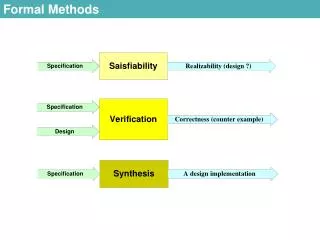
Verification as a Game • Two Players: • Environment - chooses inputs in an attempt to violate specification • System - chooses outputs in an attempt to satisfy specification Design construction:
Parity Automata NBA: (Σ, S, I⊆S, T⊆S ×Σ×S, F⊆S) Accepting run on a word σ0σ1 ...∈Σω: =q0 q1 ...∈Sω, s.t.: q0∈I, (qi,σi,qi+1)∈T,inf()F NPA (non deterministic parity automaton) (Σ, S, I⊆S, T⊆S ×Σ×S, c:V→N - coloring function ) Accepting run on a word σ0σ1 ...∈Σω: =q0q1...∈Sω, s.t.: q0∈I, (qi,σi,qi+1)∈T,Even(max{c(q) | q∈inf()}) DBA/DPA (Deterministic Buchi/Parity automaton) - |I |=1 - |{q’S | (q, , q’)T}| ≤1, qS, Σ
LTL to DPA • NBA to DPA • For every NBA there exists an equivalent DPA • The number of states in the DPA is exponential in the number • of states of the NBA. • For every LTL formula there exists a DPA As.t. L(A)=models() • The number of states in Ais doubly-exponential in the length of . Example: Finitely many ‘rqst’ imply finitely many ‘ack’ LTL: rqst Ack
Infinite Game • A gamegraph is a tuple G = (V0, V1, E, c) where • V0, V1 sets of nodes (positions), • E (V0×V1 )(V1×V0 ), a set of edges s.t. for every vV=V0+V1 • vE := {wV |(v,w)E} is finite and nonempty.
Match & Strategy Match - v0 v1 · · · V, such that i. (vi,vi+1)E. Strategy for player p{0,1} is a function fp : V*Vp V, such that (vn-1, fp(v0 v1 ··· vn-1 ))E for all prefixes v0v1·· · vn-1 with vn-1Vp. A match =v0v1v2··· conforms to a strategy fp if i. viVp fp(v0 ··· vi )=vi+1 Winning strategy for player p for a match starting at v0 is a strategy fp for player p for a match starting at v0, such that player p wins every match =v0v1v2···, where vj=fp(v0···vj-1) for every vjV1-i. (This means player i wins all matches starting at v0 if he plays according to his winning strategy.)
Safety/Reachability Game A pair(G,S) where G is a game graph and SV. Player 0 wins a match v0 v1 · · · if i. viS; o.w. player 1 wins. Example: never ‘Nack’ Example: An ‘Ack’ only in response to ‘Rqst’
Buchi Game A pair(G,S) where G is a game graph and SV. Player 0 wins a match if inf()S; o.w. player 1 wins. Example: Infinitely many ‘Ack’
Parity Game A pair(G,c) where G is a game graph and c:VN. Player 0 wins a match if max{c(v) | vinf()} is even; o.w. player 1 wins. Example: Finitely many ‘rqst’ imply finitely many ‘Ack’
Determinacy • A strategy fp is v-winning for player p and position v if all matches • that conform to fp and that start in v are won by player p. • The winning region for player p is the set of positions • Wp = {v∈V | there is a strategy fp s.t. fp is v-winning}. • A game is determined if V = W0∪W1. • A memory-less strategy for player p is a function fp : Vp→V • Which defines a strategy f’p(uv)= fp(v). • A game is memory-less-determined if for every position some • player wins the game with memory-less strategy. Theorem: safety/reachability, Buchi, and parity games are memory-less determined. Proof: by fixpoint construction (separately for each type). Thus W0, W1 are explicitly constructed and form a solution for the game.
Game Solution to a Design • Mealy machine A = (, , S, i ,T, ) • : input alphabet • : output alphabet • S: finite set of states • iS: initial state • T : S S: transition function • : S : output function • The winning strategy can be represented as a Mealy machine.
Example An ‘Ack’ only in response to ‘Rqst’