Download
1 / 3
30 likes | 163 Views
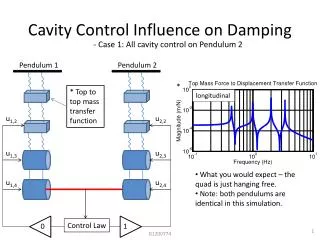
This document explores the influence of cavity control on damping through three case studies involving two identical pendulums. In Case 1, all cavity control is applied to Pendulum 2, revealing expected behavior of a free-hanging mass. Case 2 focuses on Pendulum 1, where the top mass operates as if clamped due to resonance effects from neighboring loops. Case 3 divides cavity control evenly between both pendulums, leading to a cumulative resonance behavior. These scenarios are critical for understanding resonance management in advanced gravitational wave detectors like aLIGO.

E N D
Cavity Control Influence on Damping - Case 1: All cavity control on Pendulum 2 * Pendulum 1 Pendulum 2 * Top to top mass transfer function longitudinal u1,2 u2,2 u1,3 u2,3 • What you would expect – the quad is just hanging free. • Note: both pendulums are identical in this simulation. u1,4 u2,4 Control Law 0 1 G1200774
Cavity Control Influence on Damping - Case 2: All cavity control on Pendulum 1 Pendulum 1 Pendulum 2 * * Top to top mass transfer function longitudinal u1,2 u2,2 u1,3 u2,3 • The top mass of pendulum 1 behaves like the UIM, PUM, and test mass are clamped to gnd. • This happens when the ugfs of the UIM, PUM, and test mass loops are above the quad’s resonant frequencies. u1,4 u2,4 Control Law 1 0 G1200774
Cavity Control Influence on Damping - Case 3: Cavity control split evenly between both pendulums Pendulum 1 Pendulum 2 * * Top to top mass transfer function longitudinal u1,2 u2,2 u1,3 u2,3 • The top mass response is now an average of the previous two cases -> 5 resonances to damp. • Control up to the PUM, rather than the UIM, would yield 6 resonances. • aLIGO will likely behave like this. u1,4 u2,4 Control Law 0.5 0.5 G1200774