Download
1 / 38
390 likes | 499 Views
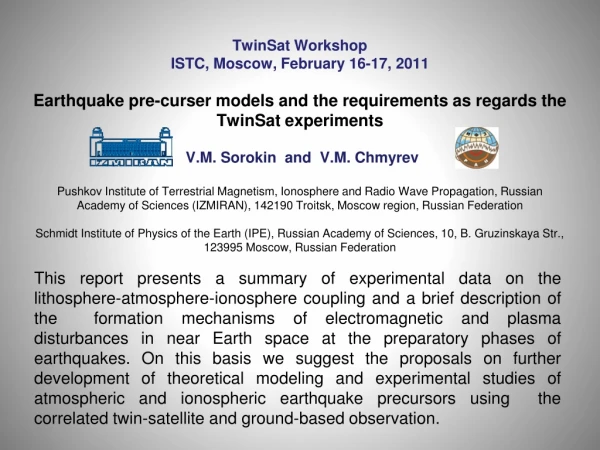
This talk by Chun-xi Wang at the ICFA workshop discusses the critical role of emittance compensation in high-brightness photoinjectors, essential for advancing X-ray free electron lasers (FELs) and electron cooling techniques. Theoretical developments are outlined, including beam-envelope theory and the effects of space-charge forces on projected emittance. Experimental results showcasing successful emittance recovery in various setups, such as LCLS and SPARC injectors, are also presented, emphasizing the ongoing significance of this research in modern accelerator physics.

E N D
Emittance compensation theoryand experimental results in HB photoinjectors Chun-xi Wang Physicist, Advanced Photon Source (ANL) Invited talk at ICFA workshop on the Physics and Applications of High-brightness Electron Beams 2009 Nov. 18, 2009 Sincerely thank the organizers (Massimo and James) for the invitation and unwavering support
solutions / pictures “We physicists love simple problems. So much so that our immediate reaction to complex puzzles is to keep staring at them until some simple picture suggests itself.” [T. Mcleish, August issue of Physics Today] I have been staring at photoinjector dynamics for a few years. Here I will share what I have seen so far. (a luxury for beam physics.)
Motivation: high-brightness photoinjectors are critical (examples) • X-ray FELs • ERL-based 4th generation light sources • Others: ERL-based electron cooling of RHIC, ILC, … Impact on ERL upgrade at APS [Borland et al. whitepaper on ERL] Impact on a 1.5 A SASE FEL [Kim et al. whitepaper on bright e-beam, ANL/APS/LS-305] 0.1mm 0.3mm LCLS 1mm APS XFEL-O demands 0.1mm @ 40pC, 1MHz [Kim et al. PRL100, 244802(2008)] 3mm 10mm
hn rf photoinjector layout (examples) UCLA/SLAC/BNL S-band next gen. RF Gun [Serafini, Joint Accelerator School, 2002] TTF-FEL II and TESLA-FEL RF Gun @ L-band 800 ms pulses @ 5 Hz (multi bunch trains @ 1-10 MHz to fill the TESLA SC Linac)
Matching onto the Local Emittance Max. This brings to Ferrario’s working point, adopted by LCLS and TTF-FEL II Final emittance = 0.4 mm Transverse emittance evolution in a compensated injector [Serafini, Joint Accelerator School, 2002] S-band photoinjector up to 150 MeV, HOMDYN simulation (RF Gun + 2 Traveling Wave Structures) Q=1nC, L=10ps, R=1 mm, Epeak=140 MV/m, TW Eacc = 25 MV/m
px projected slice x Emittance compensation --- theoretical developments • Oscillation and growth of projected emittance • linear space charge dominate, nonlinearities are small, slice emittance is preserved • but projected bunch emittance oscillates and grows due to different space-charge defocusing among slices and chromatic effects and so on • emittance compensation is a the cure [Carlsten, NIM A285,313(1989)] • Emittance compensation is critical to achieve high-brightness proper focusing can recover the projected emittance • First beam-envelope theory [Serafini & Rosenzweig, PRE55,7565 (1997)] • Recent efforts [C.-x. Wang, NIM A557, 94 (2006)] [C.-x. Wang, PRE 74, 046502 (2006)] [C.-x. Wang, K.-J. Kim, M. Ferrario, A. Wang, PRST-AB 10, 104201 (2007)] [C.-x. Wang, PRST-AB (2009)] • Simulations are still the workhorse for design Many other works can’t be covered here, e.g., [X. He, C. Tang, W. Huang, Y. Lin, NIM A560,197 (2006)] Orbit-theory approach: [K.-J. Kim, NIM A275, 201 (1989)] [Z. Huang, Y. Ding, J. Qiang, NIM A593, 148 (2008)]
Emittance compensation --- experiments • First observation through slice emittance measurement [X. Qiu, K. Batchelor, I. Ben-Zvi, X-J. Wang, PRL 76(20) 3723 (1996)]
Emittance compensation --- experiments • First observation through slice emittance measurement [X. Qiu, K. Batchelor, I. Ben-Zvi, X-J. Wang, PRL 76(20) 3723 (1996)] • Direct measurement of the double emittance minimum using emittance meter [M. Ferrario et. al., PRL 99, 234801 (2007)] [M. Ferrario et. al., SLAC-Pub-8400 (2000)]
Emittance compensation --- experiments • First observation through slice emittance measurement [X. Qiu, K. Batchelor, I. Ben-Zvi, X-J. Wang, PRL 76(20) 3723 (1996)] • Direct measurement of the double emittance minimum [M. Ferrario et. al., PRL 99, 234801 (2007)] [M. Ferrario et. al., SLAC-Pub-8400 (2000)] • Success of LCLS, SPARC, and other high-brightness injectors [R. Akre, D. Dowell, et. al., PR ST-AB 11,030703 (2008)] [Y. Ding, et. al., PRL 102, 254801 (2009)] [A. Cianchi, et. al., PR ST-AB 11, 032801 (2008)] Emittance compensation works well in recovering emittance degradation due to linear space-charge forces. Performance starts to be limited by thermal emittance, nonlinear space charges, etc.
low charge Emittance compensation --- experiments • First observation through slice emittance measurement [X. Qiu, K. Batchelor, I. Ben-Zvi, X-J. Wang, PRL 76(20) 3723 (1996)] • Direct measurement of the double emittance minimum [M. Ferrario et. al., PRL 99, 234801 (2007)] [M. Ferrario et. al., SLAC-Pub-8400 (2000)] • Success of LCLS and SPARC injectors [R. Akre, D. Dowell, et. al., PR ST-AB 11, 030703 (2008)] [Y. Ding, et. al., PRL 102, 254801 (2009)] [A. Cianchi, et. al., PR ST-AB 11, 032801 (2008)] • Emittance compensation under velocity bunching [Serafini & Ferrario, AIP Conf. Proc. 581 (2001)] [M. Ferrario et. al., PAC 99 (2009)]
Emittance compensation --- experiments • First observation through slice emittance measurement [X. Qiu, K. Batchelor, I. Ben-Zvi, X-J. Wang, PRL 76(20) 3723 (1996)] • Direct measurement of the double emittance minimum [M. Ferrario et. al., PRL 99, 234801 (2007)] [M. Ferrario et. al., SLAC-Pub-8400 (2000)] • Success of LCLS and SPARC injectors [R. Akre, D. Dowell, et. al., PR ST-AB 11, 030703 (2008)] [Y. Ding, et. al., PRL 102, 254801 (2009)] [A. Cianchi, et. al., PR ST-AB 11, 032801 (2008)] • Emittance compensation under velocity bunching [Serafini & Ferrario, AIP Conf. Proc. 581 (2001)] [M. Ferrario et. al., PAC 99 (2009)] • Many others; apologize for the inconclusiveness.
Emittance compensation --- Simulation codes • Simulation are the workhorse for design • Envelope-equation based code HOMYDN[M. Ferrario, INFN] • Particle tracking codes ASTRA[K.Floetmann, DESY], PARMEALA[LANL], IMPACT-T[J. Qiang, LBNL], GPT[commercial code], TREDI, BEAMPATH, … • Code comparison [C. Limborg et. al., PAC03, 3548 (2003)] • Multi-objective optimization with parallelized particle tracking [I.V. Bazarov et. al., PR ST-AB 8, 034202 (2005)] • Need to combine particle tracking, envelop analysis, and theory It is important but not easy to analyze and quantify the limitations to beam brightness in a design simulation
High-brightness photoinjector dynamics are complex • Rapid acceleration from rest to relativistic • important to overcome space-charge effects • Space-charge-dominated to emittance-dominated • nonlinear space-charge force depends on details of bunch shape/laser pulse • emittance compensation is critical to overcome emittance blowup due to linear space-charge force (and more) • image-charge force near cathodes is significant • Time-dependent rf force (acceleration and focusing) • ponderomotive focusing is important and has chromatic effects • certain defocusing close to cathode • rf curvature creates nonlinearity and limits bunch length • Solenoid focusing with large fringe field • main knob for emittance compensation, chromatic effect is significant • Intrinsically nonlinear problems • forces are nonlinear, especially space-charge force • envelope equations are nonlinear,even for linear forces
Hamiltonian suitable for perturbative analysis (I) [Wang, PRE74 (2006)] • Starting with • Required features • suitable for perturbation • allow rapid acceleration from non-relativistic to relativistic • mostly decoupled / solvable form • Coordinate systems • use derivations from reference particle as dynamical variables for perturbation • use s as the explicit independent variable for convenience, but still use time t as implicit independent variable for calculating space-charge forces, and thus use (z, p ) instead of (t, -E) as longitudinal variables • use reduced-coordinates to decouple (x, px) etc. z
Hamiltonian suitable for perturbative analysis (II) • Linear Hamiltonian • 3rd order Hamiltonian The effects of this chromatic term is significant
Linear forces and linear Hamiltonian • TM01 rf field • Solenoid field • Average space-charge field • Linear Hamiltonian 0 in Larmor frame
Pseudofocusing and rf focusing/defocusing Lorentz force • Pseudofocusing • rf focusing/defocusing • Total linear rf focusing strength . important at low energy [P. Lapostolle et al, (1994)] ponderomotive focusing [Hartman & Rosenzweig, PRE47,2031 (1993)] [Rosenzweig & Serafini, PRE49,1599 (1995)]
Emittance compensation in space-charge regime [Carlsten 1989], with newly found criteria [Wang et al. 2007] Invariant envelope in constant acceleration/focusing channel practical matching condition [Serafini et al. 1997, Wang 2006] double minima in drift [Ferrario 2000, PRL2007] Transition from space-charge regime to emittance regime universal envelope equation. [Wang 2009] Emittance compensation in optimized SPARC injector e [mm]
Envelope equation, beam emittance envelope emittance linearity bunch emittance envelope equation px x Not a quadratic sum with thermal emittance
Beam envelope equation In high-brightness photoinjectors, electrons behave as laminar flow in both longitudinal and transverse planes. Thus, a bunch can be treated as many individual slices, each follows its own envelope equation.[Serafini & Rosenzweig (1997)] • b-function of time-dependent harmonic oscillator • Beam envelope equation governing (linear) transverse beam dynamics • self-consistent space-charge force is built into this equation • coefficients are rapidly changing • coefficients are slice-dependent, especially the perveance • nonlinear, nonautonomous ODE, notoriously hard to solve analytically • Emittance is very difficult to handle analytically
Invariant-envelope/equilibrium solution: generalized Brillouin flow • Invariant-envelope [Serafini & Rosenzweig (1997); Wang (2006)] • Envelope Hamiltonian • “Laminarity parameters” • Transition energy 0 0 a practical matching condition min @ . . . 2 > 10
Small envelope oscillations around equilibrium • Equation of motion for small oscillation • Propagation of small deviations ( ) Independent of slice perveance! asg [Rosenzweig & Serafini, PRE49,1599 (1995)] ,
Emittance evolution around equilibrium in a booster • Emittance evolution • Final emittance 0 booster entrance the reality is more complicated
Shortcomings of invariant-envelope theory • Emittance evolution far from equilibrium in the gun • no equilibrium at all in the gun (everything is time-dependent) and in the following drift space (no focusing) • envelopes are far away from equilibrium • lack of criteria for emittance compensation (despite the matching condition) • practical designs rely on simulations (with handwaving theory) • general perturbation theory and new compensation criteria • Transition from space-charge regime to the thermal regime • space-charge-dominated theory isn’t enough • no equilibrium solution away from space-charge regime (inadequate focusing) • perturbative solution around invariant envelope diverges • nonlinear effects are significant • universal envelope equation and emittance evolution during transition [C.-x. Wang, K.-J. Kim, M. Ferrario, A. Wang, PRST-AB (2007)] [C.-x. Wang, PRST-AB (2009)]
Envelope equation for general perturbative treatment Using small deviations to reorganize the envelop equation as
Perturbative envelope solution • To the first-order in small deviations, the envelope equation reduces to a simple inhomogeneous first-order ODE: • General solution for envelope deviations: • For the reference envelope • General envelope solution
First-order driving terms • Space-charge effect: perveance deviations among slices • Chromatic effect: [Wang, PRE74 (2006)] s[m] space-charge space-charge chromatic chromatic slice# (s-dependence) (slice-dependence)
Emittance evolution • Effects of the first-order driving terms w/ chrom e [mm] w/ s.c. s[m]
= Emittance computation formula • Hard to analytically compute • Assuming a general linear expansion & uncorrelated variations • Emittance can be computed as
residuals absorbed into s ,s’ 0 0 Emittance compensation – removal of slice-dependent effects • Estimation of driving term contributions (w/ major approximation) • Envelope expansion reduces to • Emittance can be approximated as = 0 to remove slice-dependent emittance growth
Emittance compensation criteria from cathode to booster • Criteria to minimize emittance growth from slice-dependent effects • Equivalent conditions • Equivalent integral form • It is surprisingly good = 0 booster entrance booster entrance
Emittance compensation inside booster / linac • Transition from space-charge regime to thermal regime • common to most high-brightness beam, but not well studied • invariant-envelope theory is limited to space-charge regime • intrinsic nonlinearity is significant and very hard to treat • magnetized beam can cross the transition at low energy • Some obvious questions • what happens to the invariant-envelope solution? • how restrictive is the matching condition (phase-space acceptance)? • is it possible to preserve the emittance across the transition? • any criteria besides matching to the invariant-envelope? • Recent findings: • universal envelope equation • solution of invariant-envelope across the transition • emittance formula that correctly includes thermal emittance
w/ const. focusing Universal beam envelope equation in axisymmetric linac • Scaled energy (by the transition energy) as independent variable • energy increases monotonically in linac • Scaled envelope (by the invariant envelope) as dependent variable • Envelope equation reduces to • Under linear acceleration with focusing
linear perturbation around W W Emittance evolution inside booster / linac • Under constant focusing (W = 0) exact exact relative emittance perturbation around invariant envelope approx. relative emittance
Emittance evolution in linacs -- SPARC example HOMDYN simulation vs. universal envelope (continued with the same linac) HOMDYN universal envelope computation thermal emittance quadratically included thermal emittance correctly included
Emittance compensation in space-charge regime [Carlsten 1989], with newly found criteria [Wang et al. 2007] Invariant envelope in constant acceleration/focusing channel practical matching condition [Serafini et al. 1997, Wang 2006] double minima in drift [Ferrario 2000, PRL2007] Transition from space-charge regime to emittance regime universal envelope equation. [Wang 2009] Summary e [mm]