Download
1 / 13
130 likes | 231 Views
This study discusses identifying potential neutrino sources from TeV gamma-ray sources in our galaxy, deriving neutrino flux from gamma-ray data, and event rates in neutrino telescopes. It explores various Galactic TeV gamma-ray sources and their association with neutrino production. Detailed analysis of supernova remnants, pulsar wind nebulae, and binary systems sheds light on the possibility of hadronic origins. The study provides insights into the production of neutrinos from high-energy proton interactions and the similarities between gamma-ray and neutrino spectra. Assumptions, calculations, and detector simulations are described, highlighting research on detecting neutrino signals in the Mediterranean Sea using the KM3NeT instrumented volume. Key findings and expected neutrino flux rates are presented from observed sources like Vela X, RX J1713.7-3946, RX J0852.0-4622, and others.

E N D
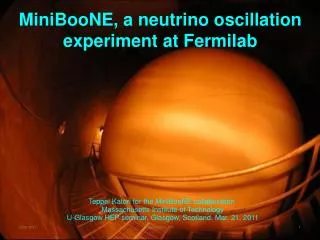
Potential Neutrino Signals fromGalactic -Ray Sources Alexander Kappes, Christian Stegmann University Erlangen-Nuremberg Felix Aharonian, Jim HintonMPI für Kernphysik, Heidelberg TeV Particle Astrophysics II Madison WI, August 28 – 31, 2006 • TeV -Ray Sources as Potential Sources • From -Rays to Neutrinos • Rates in a km3 Neutrino Telescope
Introduction • Most of our galaxy surveyed by TeV -ray detectors • Likely all bright Galactic TeV -ray sources identified) neutrino source candidates • How to derive neutrino flux from measured -ray flux? • What are the event rates in neutrino telescopes? TeV Particle Astrophysics II Madison WI, Aug. 28 - 31, 2006
Vela X (H.E.S.S.) Galactic TeV -Ray Sources (I) 7 Supernova Remnant (SNR) candidates • Detection of resolved -ray emission from shells • RX J1713-3946 (H.E.S.S.) : Multiwavelength analysis points to hadronic origin RX J1713-3946 (HESS) 12 Pulsar Wind Nebula (PWN) candidates • Normally interpreted as inverse Compton up-scattering of CMBR photons by HE electrons • But if significant fraction of nuclei in pulsar wind ) Neutrinos(Horns et al., 2006, A&A, 451, L51) TeV Particle Astrophysics II Madison WI, Aug. 28 - 31, 2006
LS 5039 H.E.S.S. Galactic Centre Ridge (H.E.S.S.) Galactic TeV -Ray Sources (II) 3 Binary Systems • Dense radiation fields rapid cooling of TeV electrons) hint to hadronic origin? • Measured -ray flux weak but strong absorption) flux “enhanced” up to a factor 100 (LS 5039)(Aharonian et al., 2006, J.Phys.Conf.Series, 39, 408) 1 Diffuse Emission from CR Interactions Structure of TeV emission similar to radio emission in CS lines from molecular clouds interaction of accelerated protons ) “guaranteed” TeV neutrino source 7 Sources without good Counterpart at other Wavelengths TeV Particle Astrophysics II Madison WI, Aug. 28 - 31, 2006
Sky Map of Known TeV -Ray Sources(Galactic coordinates) < 25% visibility*to Med. detector * > 75% visibility* to Med. detector * Visibilities for E < 100 TeV TeV Particle Astrophysics II Madison WI, Aug. 28 - 31, 2006
Hadronic neutrino and -ray production: p + p→p0 + X9 p + p→p§ + X9m+nm9 e + ne+nm Pion isospin symmetry) ( : ne: nm : nt ) ¼ ( 1 : 2 : 1 : 0 ) From -Ray to Neutrino Flux (I) Parameterisation of pion and secondary particle production (SIBYLL) (Kelner et al., astro-ph/0606058) Primary proton spectrum: Neutrino / spectrum: ) TeV Particle Astrophysics II Madison WI, Aug. 28 - 31, 2006
Norm: Index: Cut-off: From -Ray to Neutrino Flux (II) • Assuming full neutrino mixing • Relation / spectrum parameters(at Earth) p = 10 TeV p = 100 TeV p = 1 PeV TeV Particle Astrophysics II Madison WI, Aug. 28 - 31, 2006
Assumptions made for Calculations • No significant contributions from non-hadronic processes to signal • Matter density low (no significant absorption / § decay before interaction) • Radiation density low (no significant p interaction / absorption) • Magnetic field low (muons decay without significant energy loss) • Size of emitting region large (full neutrino mixing) • NN interactions produce spectra similar to pp • For all extended (H.E.S.S.) -ray sources conditions 1.– 6. likely valid (except condition 1. in several cases) • For (point like) Binary Systems probable 2. (no significant absorption) and 5. not true TeV Particle Astrophysics II Madison WI, Aug. 28 - 31, 2006
Neutrino and -Ray Spectra for RX J1713.7-3946 (SNR) measured-ray flux (H.E.S.S.) mean atm. flux(Volkova, 1980, Sov.J.Nucl.Phys., 31(6), 784) expected neutrino flux • 1 error bands include systematic errors (20% norm., 10% index & cut-off) TeV Particle Astrophysics II Madison WI, Aug. 28 - 31, 2006
Detector Simulation (KM3NeT) • Location: Mediterranean Sea • Instrumented volume: 1 km3 • Angular resolution for muons:PSF = 0.3o (E > 1 TeV) • Event rate: • comprises (full MC simulation) • attenuation in Earth • conversion to • detection efficiency (Kuch, astro-ph/0606507) • Neutrino spectrum cut-offs at few 10 TeV) earth opaqueness not taken into account • Optimal search window (flat background): TeV Particle Astrophysics II Madison WI, Aug. 28 - 31, 2006
Neutrino Rates for RX J1713.7–4622 in KM3NeT (1 km3,5 years) TeV Particle Astrophysics II Madison WI, Aug. 28 - 31, 2006
Neutrino Events from H.E.S.S. Sources Sources with observed cut-off KM3NeT (1 km3, 5 years) E > 1 TeV E > 5 TeV Type Ø [o] Src Bkg Src Bkg • Vela X PWN 0.8 9 – 23 23 5 – 15 4.6 • RX J1713.7–3946 SNR 1.3 7 – 14 41 2.6 – 6.7 8.2 • RX J0852.0–4622 SNR 2.0 7 – 15 104 1.9 – 6.5 21 • HESS J1825–137 PWN 0.3 5 – 10 9.3 2.2 – 5.2 1.8 • Crab Nebula PWN <0.1 4.0 – 7.6 5.2 1.1 – 2.7 1.1 • HESS J1303–631 NCP 0.3 0.8 – 2.3 11 0.1 – 0.5 2.1 • LS 5039* (INFC) Binary <0.1 0.3 – 0.7 2.5 0.1 – 0.3 0.5 NCP: No counterpart at other wavelengths *no -ray absorption 20 further H.E.S.S. sources investigated: • All -ray spectra show no cut-offs (but limited statistics) • Event numbers mostly below 1 – 2 in 5 years • For more details: preprint astro-ph/0607286 TeV Particle Astrophysics II Madison WI, Aug. 28 - 31, 2006
Summary • Likely, strongest Galactic TeV -ray sources discovered) neutrino source candidates • Measured -ray spectra allow robust prediction of neutrino fluxes • Simple relation between parameters of -ray and spectrum found • Event rates in a 1 km3 Mediterranean neutrino telescope (KM3NeT) • about 1 event per year from each of brightest sources (E > 1 TeV) • about equal number of background and signal events TeV Particle Astrophysics II Madison WI, Aug. 28 - 31, 2006