Solving Related Rate Problems Using Implicit Differentiation: A Step-by-Step Guide
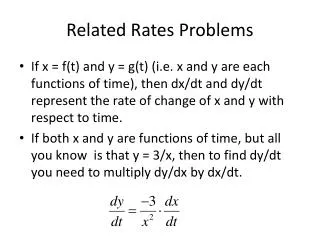
In this guide, we explore how to tackle related rate problems using implicit differentiation. We will analyze a practical scenario involving a leaking motor oil can that creates a circular puddle. The area of the puddle increases at a constant rate of 10 cm²/hr, and we will determine how fast the radius of the puddle increases after two hours, when the radius is 20 cm. By following five methodical steps—writing known and unknown derivatives, forming relevant equations, differentiating implicitly with respect to time, and finally substituting values to find the result—learn how to approach similar problems with confidence.


Solving Related Rate Problems Using Implicit Differentiation: A Step-by-Step Guide
E N D
Presentation Transcript
Differentiating implicitly with respect to t • Here’s what it looks like:
Differentiating implicitly with respect to t • Try this now:
A problem Motor oil begins leaking onto the floor from an old can in my garage. On the floor, the oil makes a perfect circle. The surface area of the puddle is increasing at a constant rate of 10 cm2/hr. After two hours (when r = 20), how fast is the radius of the puddle increasing? We’ll use five steps to tackle this: • Write down what you know in terms of derivatives. • Write down what you wantin terms of derivatives. • Write down an equation relating the variables involved. (Remember your geometry!) • Differentiate both sides implicitly with respect to t (time). • Substitute and solve for the missing quantity.
What do we know? Motor oil begins leaking onto the floor from an old can in my garage. On the floor, the oil makes a perfect circle. The surface area of the puddle is increasing at a constant rate of 10 cm/hr. After two hours (when r = 20), how fast is the radius of the puddle increasing?
What do we need to know? Motor oil begins leaking onto the floor from an old can in my garage. On the floor, the oil makes a perfect circle. The surface area of the puddle is increasing at a constant rate of 10 cm/hr. After two hours (when r = 20), how fast is the radius of the puddle increasing?
Write an equation relating the variables. Motor oil begins leaking onto the floor from an old can in my garage. On the floor, the oil makes a perfect circle. The surface area of the puddle is increasing at a constant rate of 10 cm/hr. After two hours (when r = 20), how fast is the radius of the puddle increasing?
Differentiate implicitly with respect to t Motor oil begins leaking onto the floor from an old can in my garage. On the floor, the oil makes a perfect circle. The surface area of the puddle is increasing at a constant rate of 10 cm/hr. After two hours (when r = 20), how fast is the radius of the puddle increasing?
Substitute and solve for the quantity you want to find. Motor oil begins leaking onto the floor from an old can in my garage. On the floor, the oil makes a perfect circle. The surface area of the puddle is increasing at a constant rate of 10 cm/hr. After two hours (when r = 20), how fast is the radius of the puddle increasing?
Steps for solving a related rates problem… • Write down what you know in terms of derivatives. • Write down what you wantin terms of derivatives. • Write down an equation relating the variables involved. (Remember your geometry!) • Differentiate both sides implicitly with respect to t (time). • Substitute and solve for the missing quantity.