
Hydroponics
E N D
Presentation Transcript
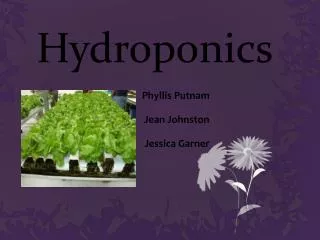
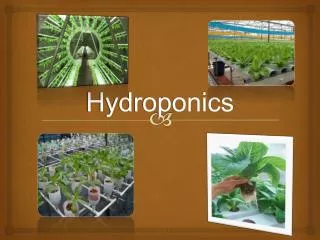
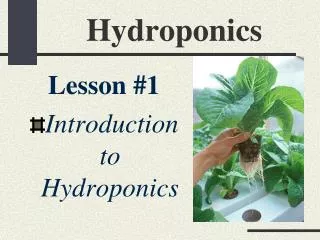
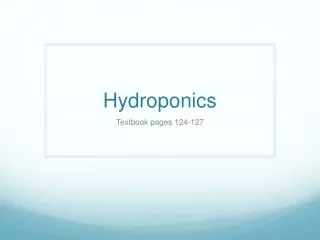
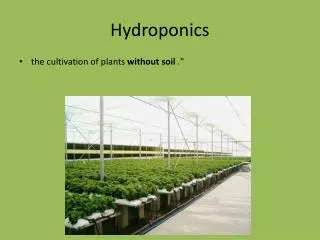
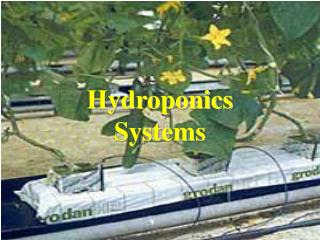
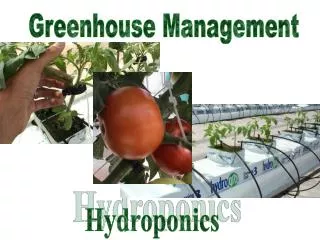
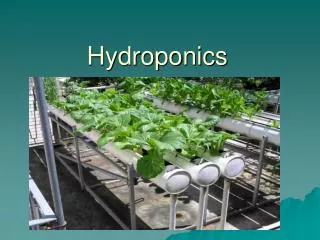
Hydroponics • The growing of plants in a solution of nutrients necessary for plant growth, rather than directly in soil.
Substrate • the substance in which something takes root
General Facts: • any plant can be grown in a hydroponics system • almost any system will produce acceptable growth
General Facts; • small scale is entirely different from the culture of several thousand plants • has contributed much to understanding plant growth
General Facts: • Very few commercial producers • Most facilities are experimental, studying plant nutrition
Different Names: • nutriculture • solution culture • slop culture • gravel culture
Requirements for home hydroponics • best possible light • humidity 50% or more • day temp 75 degrees • night temp 65 degrees
Requirements for home hydroponics • no need for special drainage system • small scale, outstanding plants such as tomatoes, radishes, lettuce, carnations, roses, cabbage etc. produced
Requirements for home hydroponics • return is not sufficient for a hobbyist to earn a living.
Facts about hydroponic growing • plants don’t do well unless all essential nutrients are available in reasonable amounts
Facts about hydroponic growing • 25 gallon container, minimum size for proper proportion of nutrients
Facts about hydroponic growing • the larger the particles in the substrate, the more often it must be watered.
Commercial use • very familiar with plants • observation can determine temps and nutrient deficiency
Commercial use • to earn a reasonable living you must grow thousands of plants
Commercial use • minimum of 100,000 square feet is needed to break even financially
Growers must know about plants • most plants are very adaptive • plants can take a lot of abuse
Growers must know about plants • plants require a minimum amount of water, food, vitamins, sleep and proper temps.
Growers must know about plants • each species has its own requirements for maximum growth
Media • almost any inert material may be used as a substrate • substrate must not decompose or be too fine
Media • River washed gravel is competitive in price with soil mixtures • aeration of roots is necessary
Various Media Types • rock • volcanic ash • vermiculite - heated mica • perlite - exploded volcanic rock 1800 degrees F.
Various Media Types • peat moss • granite or sand • idealite - concrete aggregate • water
Watering • frequency depends upon media • each time a hydroponics system is replanted, roots will be left, this increases water holding capacity
Conventional Irrigation • flooding • flood tray until water appears at surface • perforated tube is used to fill and drain media as needed
Flooding • nutrient solution is pumped back and tray is flooded again
Disadv. Of Flooding • nutrient solution can become unbalanced • bacteria and disease can be spread
Peripheral Gates • nutrient solution applied and allowed to drain away • non recirculating system • no storage tank
Peripheral Gates • bacteria and diseases are drained away • solution is sprayed on
Disadv. Of Peripheral • more expensive, solution is not reused • spraying can cause spread of disease by splashing
Ooze Tube System • drip holes in double tube • no splashes • Disadvantages: most expensive
Facts about nutrients • all plants require certain basic elements • if nutrients are missing poor growth may result
Facts about nutrients • plants need more of the major elements • any deficiency is rapidly apparent
Facts about nutrients • trace minerals are often present in tap water in sufficient amounts.
Major Elements in a basic solution • Ca - Calcium • K - Potassium • N - Nitrogen • P - Phosphorous • Mg - Magnesium
Minor Elements • Mn - Manganese • S - Sulfur • Cu - Copper • B - boron
Minor Elements • Fe - Iron • Zn - Zinc • Mo - Molybdenum
Recommendations • If less than 25 gallons of nutrient solution is needed, purchase a commercial preparation • Get a scale that can weigh to less than 0.01 oz.
Diatomaceous Earth • Skeletons of diatoms • dried and used as a filter