Applying for Financial Aid
410 likes | 427 Views
Learn everything you need to know about applying for financial aid, including cost of attendance, expected family contribution, types of aid, and the FAFSA application process.


Applying for Financial Aid
E N D
Presentation Transcript
Applying for Financial Aid Emily Culbertson, Associate Director of Financial Aid Lenet Rivas, Senior Financial Aid Advisor Office of Financial Aid Oxford College of Emory University
Who is Emory/Oxford • Emory College is a rigorous liberal arts experience in a research-university setting. Average class size is about 24 • 5,522 undergraduate enrollment • 1,462 first- year class • Oxford College is the birth place of Emory and is a challenging, small liberal arts college experience in a close-knit campus of first- and second- year students. Average class size is about 20 • 979 total enrollment • 537 first-year class • Academically equivalent, distinct by geographic locations
Topics we will discuss tonight • What is financial aid? • Cost of attendance (COA) • Expected family contribution (EFC) • Financial need • Categories, types, and sources of financial aid • Free Application for Federal Student Aid (FAFSA) • CSS Profile • Special circumstances
Financial aid consists of funds provided to students and families to help pay for postsecondary educational expenses
What is Cost of Attendance (COA)? • Direct costs- • Tuition, fees, housing, food • Indirect costs- • Travel, books, personal • Students and families should prepare to pay for these out-of-pocket • Direct + Indirect costs = Cost of Attendance • Varies widely from college to college
What is Expected Family Contribution (EFC)? • Amount family can reasonably be expected to contribute • Families contribute to the extent that they're able, and have primary responsibility • The EFC derived from the FAFSA stays the same regardless of college • Two components: • Parent contribution • Student contribution • Calculated using data from a federal application form and a federal formula
What is Financial Need? Cost of Attendance –Expected Family Contribution = Financial Need
Types of Financial Aid • Scholarships • Grants • Loans • Employment Gifted Aid Self Help Aid
Sources of Financial Aid • Federal government • Pell grants, federal work study, and federal loans • State • Hope and Zell Miller • Colleges and universities • Institutional grants and/or merit based • Private sources • Loans and/or external scholarships • Civic organizations and churches • Employers
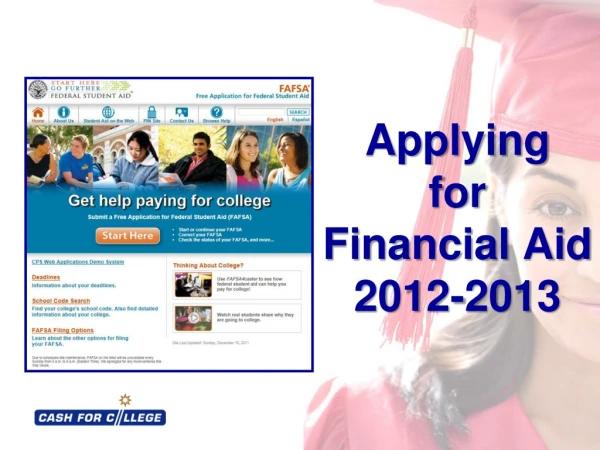
Free Application for Federal Student Aid • Collects demographic and financial information • Information used to calculate the expected family contribution (EFC) • May be filed no earlier than the October 1st prior to the academic year to which the student requests aid • Check with your school for their specific guidelines and deadlines • For the 2019-2020 academic year, the FAFSA may be filed beginning October 1st, 2018 • Most colleges set FAFSA filing deadlines
myStudentAid Mobile App • Mobile ability to begin, complete, save, and submit the FAFSA • Information protected the same as FOTW • Prompts applicant to create a save key, allowing completion at later time • FAFSA completion tracked • Successful completion of each section indicated • Digital signature • Confirmation of submission • Estimated EFC calculation
IRS Data Retrieval Tool • Allows for certain tax return information to be transferred from the IRS database • Participation is voluntary and student chooses whether or not to transfer data to FOTW • IRS will authenticate taxpayer’s identity • If tax record is found, IRS transfers information to populate the FAFSA • Reduces errors and additional documents requested by financial aid office
IRS Data Retrieval Tool • Some will be unable to use the IRS DRT • Examples include: • Did not indicate on FAFSA a tax return was completed • Marriage date is January 2017, or later • First three digits of the SSN are 666 • Filed a non-US tax return • Married and filed as head of household, or filed separate returns • Neither married parent entered a valid SSSN • Non-married parent or both married parents entered all zeroes for the SSN
General Student Information • Social Security Number • Citizenship Status • Marital Status • Drug Convictions • Selective Service registration • Level of parent’s school completion
Student Dependency Status • FAFSA asks questions to determine dependency status for federal student aid (not IRS) purposes: • If all “no” responses, student is dependent • If “yes” to any question, student is independent • https://studentaid.ed.gov/sa/fafsa/filling-out/dependency
Frequent FAFSA Errors • Social Security Numbers- ensure it matches with the social on the admission application • If either parent does not have a social, enter all 0's • Divorced/remarried parental information • Income earned by parents/stepparents • Untaxed income • U.S. income taxes paid • Household size • Number of household members in college • Real estate and investment net worth- does not include retirement • Submitting a name that doesn't match a student's legal name • Forgetting to sign and submit
Private Colleges and Universities • While the FAFSA is typically required by all colleges and universities, some schools may require additional applications to be completed • We recommend researching your top colleges and universities and identifying what is required from each school to determine aid eligibility • CollegeBoard- CSS Profile is commonly used among private colleges and universities to determine institutional need
What is the CSS Profile? • An online application for nonfederal student financial aid • Used by nearly 400 colleges, universities, professional schools, and scholarship programs to award more than $9 billion in grants • Check the College Board’s website for a list of schools and institutions that require the CSS Profile application • Available on October 1st of student's senior year • $25 fee for initial application and one college (or program report) • Additional reports at $16
Federal vs Institutional EFC • Completing the FAFSA will create a federal EFC • Similarly, completing the CSS will create an institutional EFC • It is possible that the two may not be the same; institutions may defer to the institutional EFC when awarding students with institutional aid
Divorced and Separated Parents • Noncustodial profile will be required when the marital status of the biological or adoptive parents is separated, divorced, or never married (FAFSA doesn't ask for NC information) • Waivers should be pursued where abuse, a restraining order, incarceration, or total disability, etc. exists • Documentation is necessary • Unwillingness is not a reason for a university to waive their requirement • Students need to be proactive and adhere to posted deadlines
IDOC • After completing the CSS application, you will be instructed to submit documents through the IDOC portal • Documents required may vary by school • It is important to have all documents submitted so that the school may start reviewing your file to create an award letter • IDOC will send out reminders about what forms are still missing and potentially reject some if they are incomplete
Sample Award Letter COST OF ATTENDANCE- $34,000 BILLED COSTS OUT OF POCKET COST TUITION $20,000 TRAVEL $1000 FEES $500 PERSONAL $1500 HOUSING $5,000 BOOKS $1000 FOOD $5,000 TOTAL DIRECT COST$30,500 TOTAL IN DIRECT COST$3500 $15,000 INSTITUTIONAL GRANT $13000 FEDERAL WORK STUDY $2500 FEDERAL SUBSIDIZED LOAN $3500 EXPECTED FAMILY CONTRIBUTION FINANCIAL AID PACKAGE
What is Financial Need? Cost of Attendance ($34,000- direct and indirect cost) –Expected Family Contribution($15,000) = Financial Need= ($19,000- a combination of self help aid and institutional grant)
Myintuition Myintuition.org
Special Circumstances • Cannot be documented using FAFSA • Send written explanation and documentation to financial aid office at each college (use college form where required) • College will review and request additional information if necessary • Decisions are generally final and cannot be appealed • Be mindful of college requirements for special circumstances- some have specific forms and deadlines that may be unique to that institution
Special Circumstances • Change in employment status • Unusual medical expenses not covered by insurance • Change in parent martial status • Unusual dependent care expenses • Student cannot obtain parental information
Sources of Funding • Federal and institutional need based aid (does not have to be repaid) • Merit and State aid • External scholarships • Federal subsidized and unsubsidized loans offered to the student • $5500 for the first year; interest rates fluctuate every year • Parent PLUS Loan • Apply through FAFSA; interest rates fluctuate each year; awarded up to the COA • Private Loans • Can be borrowed by either the student or the parent • ROTC
Recap • Discuss what the family can reasonably and realistically afford to pay for college • Research the schools you are most interested in and make a spreadsheet with the required applications, deadlines, and COA • Even if the cost is out of reach, we always recommend applying because you may get a better package than expected • Become familiar with myIntuition • Always fill out the FAFSA • If you are a Georgia resident, you can either submit the FAFSA every year for Hope/Zell or apply through GAfutures.org • Fill out the CSS if required • Apply to as many external scholarships as possible