Enhancing Pork Fat: The Science of Rendering and Interesterification
This presentation illustrates the process of pork fat rendering and the transformation of fatty acids via interesterification. By heating pork carcass fat with a catalyst, we can improve its physical properties, creating lard that has a more consistent texture, better melting points, and enhanced suitability for culinary applications. The visualization distinguishes between short, medium, and long-chain fatty acids, explaining how their rearrangement affects the final product. This process yields a higher quality fat for cooking, addressing the limitations of raw pork fat.

Enhancing Pork Fat: The Science of Rendering and Interesterification
E N D
Presentation Transcript
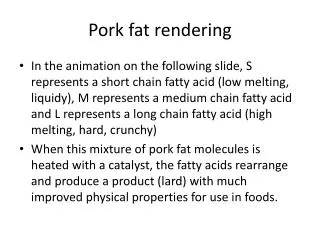
Pork fat rendering • In the animation on the following slide, S represents a short chain fatty acid (low melting, liquidy), M represents a medium chain fatty acid and L represents a long chain fatty acid (high melting, hard, crunchy) • When this mixture of pork fat molecules is heated with a catalyst, the fatty acids rearrange and produce a product (lard) with much improved physical properties for use in foods.
Rendering S Pork carcass fat-due to it’s structure it has not very good properties for use in foods, i.e., widely different textures, different melting points, smoke points, etc. S S M Taking the carcass fat and heating it in the presence of a catalyst will cause the fatty acid chains to rearrange them- selves (interesterification) so that we get three molecules that look more alike and have better properties for use in foods M M L L Lard molecules are very alike and have very similar properties L