Download
1 / 43
430 likes | 570 Views
This guide provides an in-depth look at the integumentary system and its variations throughout different life stages, including infancy, pregnancy, adolescence, and elderly aging. Key topics include common skin conditions such as acrocyanosis, mongolian spots, jaundice, striae, acne, cherry angiomas, and various types of skin lesions. Assessment techniques are outlined, including subjective and objective data collection, physical assessments, and documentation of skin lesions. Additionally, it covers diagnostic tests and management of conditions such as pressure ulcers and parasitic infestations, ensuring a comprehensive understanding of skin health.

E N D
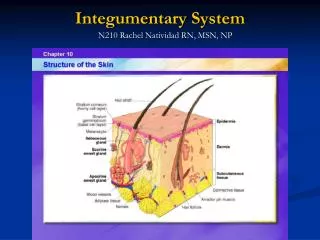
Integumentary System N210 Rachel Natividad RN, MSN, NP
Variations across the lifespan: Infancy ACROCYANOSIS MONGOLIAN SPOT JAUNDICE
Pregnancy Adolescence Variations across the lifespan: Striae Acne Linea Nigra Cherry Angioma
Elderly: Senile Lentigines (Liver spots ) WRINKLES PURPURA LIVER SPOTS LIVER SPOTS
Assessment • Subjective data • Specific Skin Complaint • Objective data • Physical assessment: Inspection and palpation • Draw picture or take photo if possible
Vesicle, Bulla Skin Lesions Types • Primary: (Initial lesions) Appear in response to external or internal environment of skin.
Primary Lesions Wheal Nodule Papule Tumor Vesicle Bulla
Skin Lesion Types Secondary Lesions: Are a result of trauma, chronicity, or infection of primary lesion.
Secondary Lesions Crust Scale Fissure Lichenification Keloid
Skin Lesion Types • Vascular Lesions: Appear as red pigmented lesion. Could be indicative of bleeding • Hemangiomas • port wine stain; strawberry mark-mature hemangioma • Telangiectasias • spider angioma with pregnancy or liver disease; venous lake • Purpuric Lesions • Petechiae • Ecchymoses • purpura
Vascular Lesions- Cont. HEMANGIOMA Petechiae Ecchymosis Spider Angioma Venous Lake TELANGIECTASIA
Vascular Lesions: Purpura Bleeding disorder Minor trauma
COLOR SHAPE/CONFIGURATION TYPE SIZE (L x W x D) in cm DISTRIBUTION/ PATTERN EXUDATES Amount Color/consistency Serous (serum) Serosanguinous (serum & blood) Sanguinous (bloody) Purulent (pus) EXERCISEDocumentation of Skin Lesions
Lesions due to trauma or abuse Bruise or wound whose shape suggests the instrument or weapon that caused it Physical signs with history that does not match the severity or type of injury indicates abuse Scalding injury, belt marks, bite marks, cigarette burns, deformity from untreated fracture Pattern Injury from Physical Abuse
Diagnostic Tests • Culture • Skin Biopsies • Punch • Shave • Excisional • Woods Light • Diascopy • Skin Testing
Parasitic Infestations CORPORIS CAPITIS PUBIS
Infestations cont. • Scabies • A contagious disease • Transmission: close and prolonged contact or infected bedding
Infestations Cont. • Scabies lesion distribution
Pressure Ulcers • Tissue damage caused by the skin and underlying soft tissue are compressed between bony prominence and an external surface for an extended period.
Describe ulcer Stage Location Size Shape Appearance Drainage Odor Stage Presence of infection Foul smell Purulent drainage Heat, extreme redness, edema Ulcer Assessment