Understanding Induction Proofs: Concepts and Applications in Mathematics
This document explores the concept of mathematical induction, including its basic structure and applications in proofs. It covers the principles of weak and strong induction, examples of graph coloring, and techniques for verifying claims in mathematics. The lecture also discusses problems such as postage combinations and the Nim game, demonstrating how induction can be applied to a variety of scenarios in discrete mathematics. Additionally, tips are provided for constructing effective induction proofs, emphasizing the importance of base cases and inductive hypotheses.

Understanding Induction Proofs: Concepts and Applications in Mathematics
E N D
Presentation Transcript
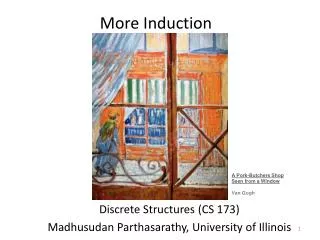
More Induction A Pork-Butchers Shop Seen from a Window Van Gogh Discrete Structures (CS 173) Madhusudan Parthasarathy, University of Illinois
Midterm grades • Freshmen: formal roster • People did very well, in general. • Thanks to TAs; very lenient grading • Estimated grade thus far • A+,A, A-: 90 or above; • B+, B, B-: 80 or above; • C+, C, C-: 70 or above • D ,F : you need to be worried; come talk to us
Does domino n fall? • Suppose domino k falls. Then domino k+1 falls.
Does domino n fall? • Suppose domino k falls. Then domino k+1 falls. • The first domino falls
Induction Inductive hypothesis: Suppose domino k falls. Inductive conclusion: Domino k+1 falls. Base case: The first domino falls.
Basic structure of induction proof Claim: Base: is true. Inductive step: or Weak Induction Inductive hypothesis Inductive conclusion Strong Induction
Today’s lecture • Induction template • More examples of induction proofs • Graph coloring • Multiple base cases • Another strong induction • Prime factorization • Towns connected by one-way streets
Graph coloring Claim: For any positive integer , if all nodes in a graph have degree , then can be colored with colors.
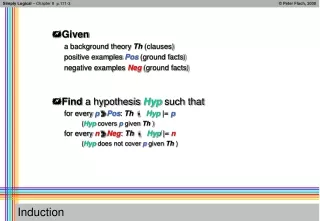
Graph coloring Claim: For any positive integer , if all nodes in a graph have degree , then can be colored with colors. P(n): Any graph G with n nodeswhere all nodes have degree D+1 colors Structure of proof:
Postage example (with strong induction) Claim: Every amount of postage that is at least 12 cents can be made from 4- and 5-cent stamps.
Postage example (with strong induction) Claim: Every amount of postage that is at least 12 cents can be made from 4- and 5-cent stamps.
Nim Nim: Two piles, two piles of matches. Each player takes turns removing any number of matches from either pile. Player that takes last match wins. Claim: If the two piles contain the same number of matches at the start of the game, then the second player can always win.
Prime factorization Claim: Every positive integer can be written as the product of primes.
Tips for induction • Induction always involves proving a claim for a set of integers (e.g., number of nodes in a graph) • Sketch out a few simple cases to help determine the base case and strategy for induction • How many base cases are needed? • How does the next case follow from the base cases? • Carefully write the full inductive hypothesis and what you need to show • Make sure that your induction step uses the inductive hypothesis to reach the conclusion
Next class • Recursive definitions