Neptune
Neptune. By: Macy and Whitney. Neptune was named by astronomers in 1846. They named it Neptune after the Roman God of the sea Poseidon. Neptune means the sea. The Discovery of Neptune. Neptune was discovered on September 23, 1846.

Neptune
E N D
Presentation Transcript
Neptune By: Macy and Whitney
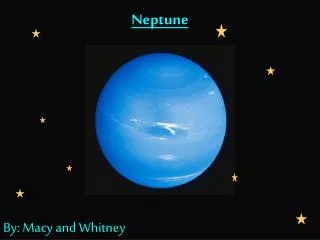
Neptune was named by astronomers in 1846. They named it Neptune after the Roman God of the sea Poseidon. Neptune means the sea.
The Discovery of Neptune • Neptune was discovered on September 23, 1846. • It was discovered by German astronomer Johann Gottfried Galle, and astronomer student Louis d’Arrest.
Neptune’s Interior Neptune’s interior make-up is primarily methane ice, just as Uranus’ is. Heat generated within Neptune helps form the unusual winds of the atmosphere.
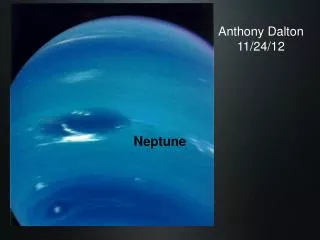
Neptune’s Atmosphere • Neptune’s composition consists of hydrogen, helium, water and minerals known as silicates. • Neptune also has 3 basic storms known as the Great Dark Spot, the Small Dark Spot, and Scooter.
Neptune’s year is 165 Earth years. Its day is 16 hours and 7 minutes.
DATA Diameter: 30,500 miles Distance from the Sun: 2,798,800,000 miles Mass: 5% of Jupiter’s mass [102,000,000,000,000,000,000,000,000 kg] Surface Gravity: 1.14 times the gravity on Earth Average Temperature: -218 degrees Celsius Length of Sidereal Day: 16 hours and 7 minutes Length of a year: 165 Earth years Observed Moons: Triton, Thalassa, Despina, Galatea, Larissa, Proteus, Nereid, Naiad, Halimede, Sao, Lasmedeia, Pasamathe and Neso
Facts about Neptune • Neptune does have rings. • It has 13 moons that have been named. • Neptune has the strongest wind speeds in our solar system, they can be up to 2,000 km/hour. • One of Neptune’s moons Triton has a retrograde orbit.
More Facts About Neptune • Neptune is the eighth planet from the sun. • Neptune is more that 2 billion miles from Earth. • Neptune orbits the sun every 165 years. • The largest storm on Neptune is known as the Great Dark Spot and would nearly cover the Earth if on our planet.
Bibliography • http://library.thinkquest.org/C002416/neptune/index.htm • http://greece.mrdonn.org/greekgods/NeptunePoseidon.gif • http://www.thefreedictionary.com/Neptune • http://galenet.galegroup.com/servlet/KidsInfoBits?vrsn=127&locID=avlr&failover=0&sgcmd=MAIN&srchtp=basic&c=5&sub=%2522Neptune+%28Planet%29%2522&ste=33&tbst=tbasic&tab=1&txb=Neptune+%28Planet%29&docNum=BX3200950595&bConts=35 • http://www.windows2universe.org/neptune/images/neptune_cutbk_sm.GIF • http://www.google.com/imgres?imgurl= • http://www.universetoday.com/21651/mass-of-neptune/ • http://www.universetoday.com/21639/gravity-on-neptune/ • http://www.universetoday.com/21669/temperature-of-neptune/ • http://www.google.com/imgres?imgurl= • http://www.windows2universe.org/neptune/images/neptune_cutbk_sm.GIF&imgrefurl= http://www.windows2universe.org/neptune/planet_structure. • http://burro.astr.cwru.edu/stu/neptune_moons.html • http://windows2universe.org/neptune/planet_structure.html • http://kencroswell.com/Neptune.jpg
Bibliography • http://www.factsmonk.com/facts_about_neptune • http://2.bp.blogspot.com/_1CASmuUog1s/SltlYd7Dr4I/AAAAAAAAsJY/CJqiGB0ZfyY/s320/Heinrich_Louis_d%27Arrest.jpg • http://upload.wikimedia.org/wikipedia/commons/d/da/JohannGalle.jpg