Distance Vector Routing
Distance Vector Routing. 박주호. Introduction. Modern computer Network generally use Dynamic routing algorithms rather than The static one. Two dynamic algorithm Distance vector routing Link state routing. Distance vector routing. This algorithms operate by

Distance Vector Routing
E N D
Presentation Transcript
Introduction. • Modern computer Network generally use Dynamic routing algorithms rather than The static one. • Two dynamic algorithm • Distance vector routing • Link state routing juhpark@cs.chonbuk.ac.kr
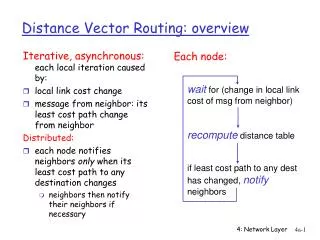
Distance vector routing • This algorithms operate by • Having each router maintain a table • The table(i.e vector) give • the best known distance to each destination and • which line to use to get there. Updated by exchanging information with the neighbors. juhpark@cs.chonbuk.ac.kr
History • Sometimes called by other names… • Distributed Bellman-Ford routing algorithm(1957) • Ford-Fulkerson algorithm(1962) • It was original ARPANET routing algorithm • And was used • In the Internet(RIP) • In early versions of DECnet and Novell’s IPX • AppleTalk and Cisco routers use improved distributed vector protocols. juhpark@cs.chonbuk.ac.kr
The Routing table • Each router maintains a routing table • Contain one entry. • Two part of one entry • The preferred outgoing line • An estimate of the time or distance • The router is assumed to know the “distance” to each of its neighbors. juhpark@cs.chonbuk.ac.kr
The Metric of distance • Number of hops • The distance is just one hop • Time delay in milliseconds • The router can measure… • Using special ECHO packets(timestamps) • Total number of packets queued along the path • The router simply examines each queue juhpark@cs.chonbuk.ac.kr
New estimated dealy from J To A I H K Line A 0 24 20 21 8 A B 12 36 31 28 20 A C 25 18 19 36 28 I D 40 27 8 24 20 H E 14 7 30 22 17 I F 23 20 19 40 30 I G 18 31 6 31 18 H H 17 20 0 19 12 H I 21 0 14 22 10 I J 9 11 7 10 0 - K 24 22 22 0 6 K L 29 33 9 9 15 K JA delay is 8 JI delay is 10 JH delay is 12 JK delay is 6 New routing table for J Vectors received from J’s four neighbors Algorithm JA = 8 JA = 8 AB = 12 JB = JA+AB = 20 (a) Receive table from neighbors Distances to each neighbor (b) juhpark@cs.chonbuk.ac.kr
A A B B C C D D E E The Count-to-Infinity Problem • Distance vector routing works in theory • A serious drawback in practice • Reacts rapidly to good news, • But leisurely to bad news. • Initially 1 After 1 exchange 1 2 After 2 exchange 1 2 3 After 3 exchange 1 2 3 4 After 4 exchange 1 2 3 4 Initially 3 2 3 4 After 1 exchange 3 4 3 4 After 2 exchange 5 4 5 4 After 3 exchange 6 5 6 After 4 exchange 7 6 7 6 After 5 exchange 7 8 7 8 After 6 exchange juhpark@cs.chonbuk.ac.kr
In case good news. • If longest path of subnet is N hops, • Everyone will know good news. • In case bad news. • Infinity… • Set infinity to the longest path + 1. • If metric is time delay, no well-defined upper bound. • There is a tradeoff… juhpark@cs.chonbuk.ac.kr
A B C D E The Split Horizon Hack • Many ad hoc solutions to the problem have been proposed… • But, complicate , useless … • One of them will be described(why fail?) • The Split Horizon Hack algorithm 1 2 3 4 Initially 2 3 4 After 1 exchange 3 4 After 2 exchange • 4 After 3 exchange After 4 exchange juhpark@cs.chonbuk.ac.kr
A B C Router D Fig. 5-12. An example where split horizon fails. juhpark@cs.chonbuk.ac.kr