Download
1 / 32
320 likes | 426 Views
This PowerPoint presentation explores the internment of 112,000 Japanese Americans during World War II, a significant racial incident. The content delves into the factors leading to the internment, the conditions in the relocation camps, and the aftermath of this controversial policy. Through primary sources and historical images, the presentation aims to shed light on this dark chapter of American history and its implications. Learn about the societal tensions, government decisions, and individual experiences that shaped this period. Reflect on the impact of fear, racism, and political pressures on civil liberties in times of crisis.

E N D
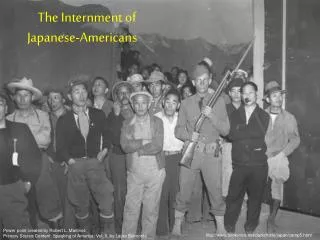
The Internment of Japanese-Americans Power point created by Robert L. Martinez Primary Source Content: Speaking of America: Vol. II, by Laura Belmonte http://www.bookmice.net/darkchilde/japan/camp5.html
During the war years, the rise of defense industries triggered a massive social migration. Millions left rural areas and moved to the cities seeking defense jobs. http://www.thefightingfalcon.org/gibsoninterior_med.jpg
This population shift generated social tensions as migrants competed for jobs and housing. http://www.archives.gov/research/african-americans/ww2-pictures/images/african-americans-wwii-248.jpg
In 1943 alone, forty-seven cities reported racial clashes. The bloodiest occurred in Detroit, where a June riot left thirty-four people dead and two million dollars in property damage. http://www.white-history.com/hwr54i_files/detriot_1943_arrest.jpg
http://www.white-history.com/hwr54i_files/detriot_1943_arrest.jpghttp://www.white-history.com/hwr54i_files/detriot_1943_arrest.jpg
The following month, hostilities between white servicemen and Latino pachucos degenerated into four days of violence in Los Angeles. http://www.calstatela.edu/orgs/mecha/zoot2.jpg
The internment of 112,000 Japanese Americans living on the West Coast was the era’s most notorious racial incident. http://www.bookmice.net/darkchilde/japan/camp5.html
California had a long history of intolerance toward Asians and Asian Americans. http://www.bookmice.net/darkchilde/japan/japan/dis2.jpg
Unlike Italian Americans or German Americans, Japanese Americans were a relatively small and isolated community focused in three states. http://www.bookmice.net/darkchilde/japan/camp5.html
Following the Pearl Harbor attack, fears of Japanese subversion and racism fueled popular demands that “Japs” be imprisoned. http://www.olive-drab.com/images/pearl_harbor_top_375.jpg
In February 1942, despite the fact that not a single Japanese American had been found guilty of disloyalty or espionage, President Franklin Roosevelt succumbed to political pressure and issued Executive Order 9066. http://www.fdrlibrary.marist.edu/od9066ph.html
The directive forced Japanese Americans living in California, Oregon, and Washington to live in relocation camps for the duration of the war. http://www.fdrlibrary.marist.edu/od9066ph.html
The decision outraged Japanese Americans, more than two-thirds of whom were U.S. citizens. http://www.flickr.com/photos/mliu92/2265586728/
Receiving only seventy-two hours notice, they were forced to sell their property and possessions at very discounted prices and then report to internment centers scattered throughout the West. http://arcweb.sos.state.or.us/exhibits/ww2/threat/eo9066.htm
Armed guards patrolled the camps, and living conditions were usually poor. http://www.bookmice.net/darkchilde/japan/camp5.html
http://www.southlandrealestate.com/images/JapaneseInternment.jpghttp://www.southlandrealestate.com/images/JapaneseInternment.jpg
Ironically, the order did not apply to Hawaii, the U.S. territory with the highest percentage of Japanese Americans. http://www.capaa.wa.gov/images/girl_ja.jpg
Weaknesses in the relocation policy became apparent. A shortage of agricultural workers prompted the government to release several internees almost immediately. http://www.bookmice.net/darkchilde/japan/camp5.html
Private humanitarian groups secured the release of hundreds of young people by offering college scholarships or vocational training. http://www.bookmice.net/darkchilde/japan/camp5.html
Thousands of Japanese-American men got out of the camps by enlisting in armed services. http://www.bookmice.net/darkchilde/japan/camp5.html
http://www.picturehistory.com/images/products/0/4/4/prod_4439.jpghttp://www.picturehistory.com/images/products/0/4/4/prod_4439.jpg
Although the Supreme Court upheld the constitutionality of the internment policy in Korematsu v. United States (1944), the government began releasing internees as wartime hysteria subsided. http://www.bookmice.net/darkchilde/japan/camp5.html
In 1988, the U.S. Congress issued an apology and awarded $20,000 to each of the 80,000 survivors of the relocation program. http://www.nps.gov/archive/miin/home.htm