Collaboration Among Educators
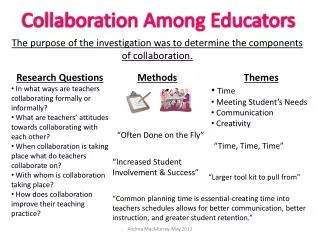
This investigation explores the essential components of collaboration among educators. It addresses key research questions regarding the nature of formal and informal collaborations, teachers' attitudes towards collaborative efforts, and the subjects of their collaboration. It highlights the impact of collaboration on teaching practices and student engagement. Themes identified include communication, creativity, and the importance of scheduled planning time for better instructional outcomes. The findings emphasize how collaboration leads to increased student involvement and improved success rates.

Collaboration Among Educators
E N D
Presentation Transcript
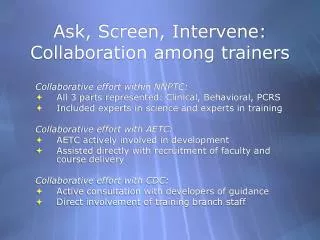
Collaboration Among Educators The purpose of the investigation was to determine the components of collaboration. • Research Questions • In what ways are teachers collaborating formally or informally? • What are teachers’ attitudes towards collaborating with each other? • When collaboration is taking place what do teachers collaborate on? • With whom is collaboration taking place? • How does collaboration improve their teaching practice? Methods • Themes • Time • Meeting Student’s Needs • Communication • Creativity • “Often Done on the Fly” • “Time, Time, Time” “Increased Student Involvement & Success” “Larger tool kit to pull from” “Common planning time is essential-creating time into teachers schedules allows for better communication, better instruction, and greater student retention.” Andrea MacMurray-May 2012
Additional Readings • Bacon, P. S. (2008). Collaboration: The next steps. Library Media Connection, 26(6), 36-37. Retrieved from http://www.linworth.com/lmc/ • Berry, B., Daughtrey, A., & Wieder, A. (2009). Collaboration: Closing the effective teaching gap. Document from Center for Teaching Quality, Retrieved from http://www.teachingquality.org • Hindin, A., Morocco, C. C., Mott, E. A., & A, C. M. (2007). More than just a group: Teacher collaboration and learning in the workplace. Teachers and Teaching: Theory and Practice, 13(4), 349-376. doi:10.1080/13540600701391911 • Schneider, F. J. (2007). Teaching collaboration to education majors. Community College Enterprise, 13(2), 7-25. Retrieved from http://www.schoolcraft.edu/ccE Andrea MacMurray (603) 357 – 0299 andrea.macmurray@myfairpoint.net Andrea MacMurray-May 2012