Download
1 / 4
40 likes | 143 Views
Update your journal and practice drawing e-dots for calcium and fluorine on half sheet. Grade your work on ionic or covalent bonds, drawing e-dot compounds with proper atom placement. Follow instructions to draw Fluorine and Calcium atoms, ions, and compounds correctly, understanding octet rule and electron transfer. Practice writing formulas for compounds. Stay organized with clear diagrams.

E N D
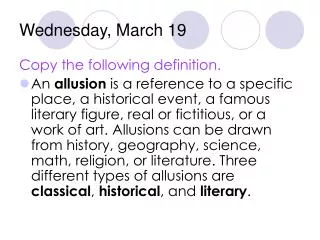
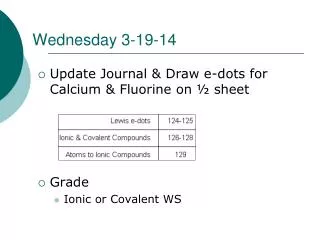
Wednesday 3-19-14 • Update Journal & Draw e-dots for Calcium & Fluorine on ½ sheet • Grade • Ionic or Covalent WS
No Warm UP. Instead draw the e-dots for Calcium and Fluorine on this sheet. (Make sure the metal is in the metal box) e-dot compounds • Draw the e-dots for Fluorine and Calcium in the correct boxes below • Draw Fluorine and Calcium together in the compound box but fix each atom to become an ion. (octet rule) • The metal will give it’s “extra” electrons to the nonmetal. (Draw an arrow showing where the electron came from to where it is going.) • If the nonmetal does not have enough vacant spaces for it, then use more nonmetals. • If the metal does not have enough electrons to give, then use more of that metal • Write the formula by writing the metal first then the nonmetal - - +2 CaF 2 CaF2 Ca2+ + F- + F-
To Do: • Ions in Compounds Activity
11p 15 n 11p 12 n Thursday 3-21-13 • WU: Draw the following then Label each as an atom, ion, or isotope. • Explain why each is what it is! 11p 12 n Ion Isotope Atom