Understanding the International System of Units (SI)
110 likes | 219 Views
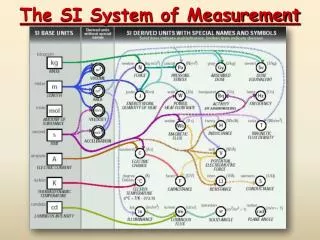
The International System of Units (SI) provides a standardized way to measure mass, length, volume, time, and the amount of a substance. It emphasizes the importance of using units like meters instead of miles, liters instead of gallons, and grams for mass. This system includes derived units for advanced measurements, such as velocity in meters per second (m/s²). Understanding the difference between mass and weight is crucial; mass is constant regardless of gravity, while weight varies with gravitational pull. Using the King Henry chart can simplify conversions for various prefixes, ensuring accuracy in scientific measurements.


Understanding the International System of Units (SI)
E N D
Presentation Transcript
SI Measurement • Le System international d’Unites • Internationally agreed • 75 000 not 75, 000 • Meters not miles • Liters not gallons
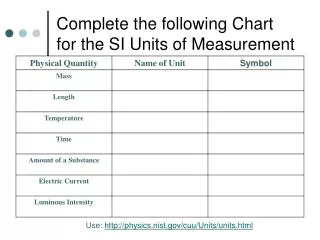
Units? • mass • length • Volume • Time • Amount of a substance
Other Units • Derived unit – combination of units like in velocity m/s2, or pressure kg/m s2 • Density – g/cm
Density • D = m/v • Ratio of mass to volume • The mass divided by the volume • Physical property
Mass • kilogram is the standard • 1000 grams • We use grams – more useful in science class. • King Henry Chart • Remember • Mass measure of matter, does not depend on gravity • Weight – measure of the gravitational pull on the mass
Mass and weight • mass is the amount of matter and will not change with location • Weight is a measure of gravity and will change with location
How to convert • King Henry chart – memorize • King Henry drank uho delicious chocolate milk • Kilo Hecto daka ______deci centi milli
Larger prefixes • Mega • Giga • tera
Smaller prefixes • Micro • Nano • Pico • Femto • atto
Multiple conversions • Affects density, area etc • If the unit is squared, you need to convert twice. • If the unit is cubed you need to convert _______________
Practice • Pg 60. #31-34