
Sample Question
The decline of the Roman, Han, and Gupta empires can be attributed to several significant factors. One critical reason was intensified invasions and heightened security issues along their frontiers, which weakened their defenses. Other contributing elements included prolonged droughts affecting agricultural stability and reliance on slave labor. Additionally, the socio-political climate influenced these civilizations, with issues related to governance and internal strife shaping their eventual downfall. Understanding these factors provides insights into the challenges faced by great empires.

Sample Question
E N D
Presentation Transcript
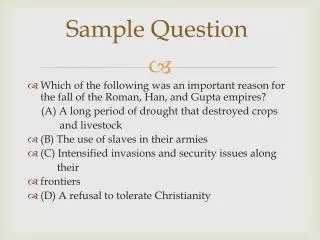
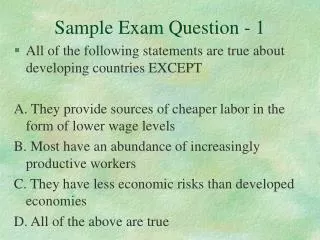
Sample Question • Which of the following was an important reason for the fall of the Roman, Han, and Gupta empires? (A) A long period of drought that destroyed crops and livestock • (B) The use of slaves in their armies • (C) Intensified invasions and security issues along their • frontiers • (D) A refusal to tolerate Christianity
Period I (600 bce – 600 ce) Older religions “codified” (written down) • Hinduism: • The Rig Veda • The Upanishads • Judaism • Old Testament • Ten Commandments
Period I (600 bce – 600 ce) Growth of New Religions • Buddhism • In India, ~530 bce • MauryanEmperor Asoka encouraged • Trade routes • Into China, Japan • Into SE Asia
Beliefs Systems • Confucianism • In China, ~500 bce • By Kong Fuzi, philosophical beliefs • The Analects promoted: • education • service to country • filial piety • justice
Beliefs Systems • Christianity • In Middle East, ~0 ce • By Jesus • New Testament • Eternal salvation • Similarities to Buddhism • Kindness to others • Peaceful coexistence
Artistic Expression • Literature & Drama • Greek plays • Indian epics • Architecture • Distinctive styles • Rome, India, China, Mesoamerica
States & Empires • SW Asia: The Persian Empires • Achaemenid, Parthian, Sassanid • E. Asia: Qin & Han • S. Asia: Mauryan & Gupta • Mediterranean: Pheonicians, Greek city-states, Hellenistic & Roman Empires • Mesoamerica: Teotihuacan & Maya city-states • Andean So. America: Moche
Administrative Institutions • Central governments • Elaborate legal systems • Complex bureaucracies • Examples: • Persia • China • Rome • India
Military Power Governments funded military power • Techniques included: • Diplomacy • Developing supply lines • Building defensive walls • Recruiting personnel from conquered lands
State & Empires Success of empires • Depended on: • strength of trade • building of roads/infrastructure • use of currency • unifying weights & measures
Classical Age600 bce – 600 ce Cities as empirical trade centers Persopolis Chang’an Pataliputra Athens Carthage Rome Alexandria Constantinople Teotihuacan
Classical Age • Class hierarchies • Patriarchy grows and becomes firmly entrenched • Trans-regional networks of trade and communication
Trade Routes • Development of Silk Road • Development of Indian Ocean Basin Trade (IOBT)








![[Sample Question] PeopleCert PRINCE2 Foundation Certification](https://cdn5.slideserve.com/9999020/how-to-prepare-for-peoplecert-prince2-foundation-dt.jpg)